
Baking a Birthday Cake in Spanish: Kitchen Vocabulary & Story 🎂
Learn beginner Spanish with a funny story about a birthday cake mix-up! Master essential food, kitchen, and celebration vocabulary in context.
- Video 24 of 55 in this unit
- Beginner · A1 — First words, greetings, and basic phrases
- Immersion — for mastery, on the Immersion path only
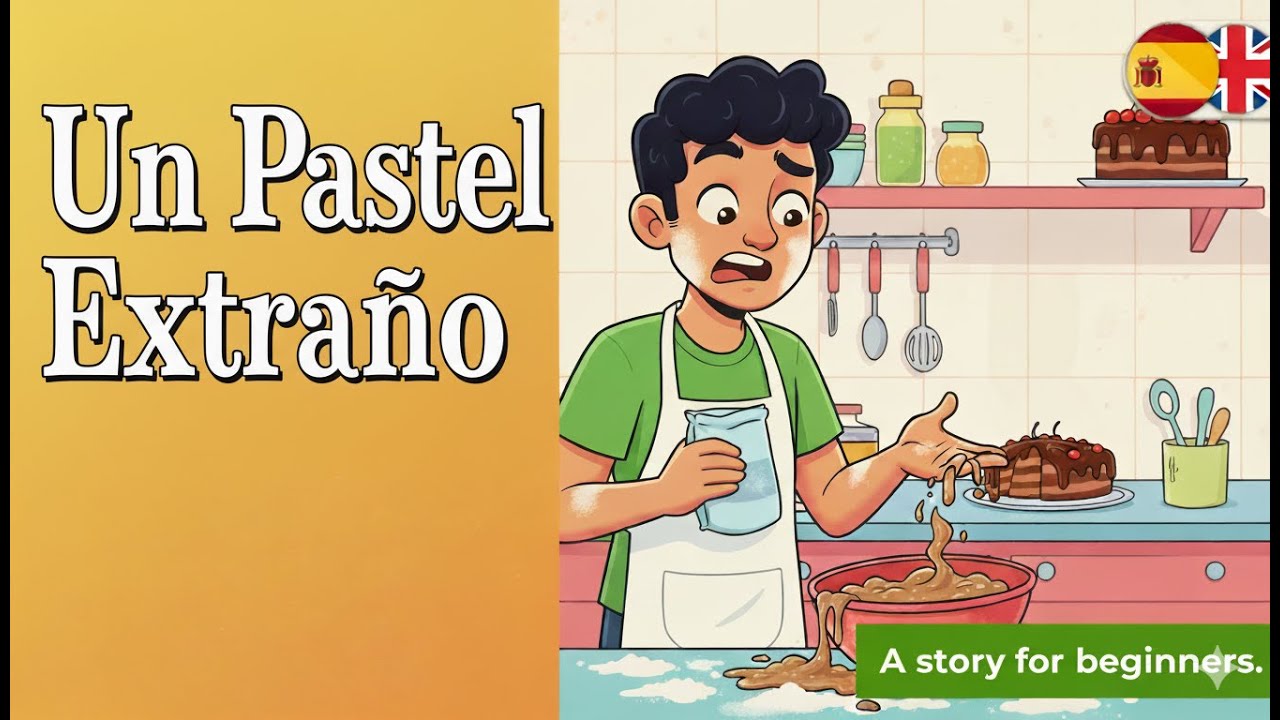
Ever since Don Gabriel helped fix my kitchen pipes, I have been moving fast, because I’m Diego and I need this surprise birthday treat for Maria to turn out perfectly before she knocks. O sea, I meant to bake a delicious pastel (“cake”), but I just realized I grabbed the salt jar instead of the sugar! In this lesson, you will learn to extend social invitations, share warm wishes like ¡Muchas felicidades! (“Congratulations!”), and navigate lively Mexican dining hospitality.
💬 Video Transcript
Follow along with the full story transcript. The English translation is provided below each line.
Diego: Hola, soy Diego. Hoy es un día muy especial. Es el cumpleaños de mi amiga, Maria. Quiero una sorpresa para ella. ¡Decido preparar un pastel!
(Diego: Hello, I’m Diego. Today is a very special day. It’s my friend Maria’s birthday. I want a surprise for her. I decide to prepare a cake!)
Diego: Voy a mi cocina. Miro una receta fácil en mi teléfono. Necesito harina, huevos, leche y azúcar. Reviso los armarios. Tengo harina, huevos y leche. ¡Perfecto!
(Diego: I go to my kitchen. I look at an easy recipe on my phone. I need flour, eggs, milk, and sugar. I check the cupboards. I have flour, eggs, and milk. Perfect!)
Diego: Ahora, busco el azúcar. En un estante, veo dos frascos blancos. Son idénticos. Un frasco tiene azúcar y el otro tiene sal. Tomo un frasco. No leo la etiqueta. Pienso que es el azúcar. ¡Qué error!
(Diego: Now, I look for the sugar. On a shelf, I see two white jars. They are identical. One jar has sugar and the other has salt. I take a jar. I don’t read the label. I think it’s the sugar. What a mistake!)
Diego: Pongo todos los ingredientes en un bol grande. Primero, la harina. Después, los huevos y la leche. Finalmente, pongo mucho polvo del frasco blanco. Mezclo todo muy bien. La masa parece normal.
(Diego: I put all the ingredients in a big bowl. First, the flour. Then, the eggs and the milk. Finally, I put a lot of powder from the white jar. I mix everything very well. The batter looks normal.)
Diego: Pongo el pastel en el horno. Espero treinta minutos. El apartamento huele delicioso. Estoy muy orgulloso. Saco el pastel del horno. ¡Es un pastel muy bonito! Es grande y dorado.
(Diego: I put the cake in the oven. I wait thirty minutes. The apartment smells delicious. I am very proud. I take the cake out of the oven. It’s a very beautiful cake! It’s big and golden.)
Diego: Poco después, Maria llega a mi casa. Yo grito: “¡Sorpresa, Maria! ¡Feliz cumpleaños!”. Le muestro el pastel. Maria sonríe. Está muy feliz. Ella dice: “¡Gracias, Diego! ¡Qué bonito!”.
(Diego: A little later, Maria arrives at my house. I shout: “Surprise, Maria! Happy birthday!”. I show her the cake. Maria smiles. She is very happy. She says: “Thank you, Diego! How beautiful!”)
Diego: Corto dos trozos grandes. Un trozo para Maria y un trozo para mí. Nos sentamos en la mesa. Los dos tomamos nuestros tenedores. Yo digo: “¡A la de tres! Uno, dos… ¡tres!”. Comemos un poco de pastel.
(Diego: I cut two big pieces. One piece for Maria and one piece for me. We sit at the table. We both take our forks. I say: “On the count of three! One, two… three!”. We eat a little bit of cake.)
Diego: ¡Puaj! ¡El pastel sabe horrible! Es muy, muy salado. No es nada dulce. Mi cara es de sorpresa y asco. La cara de Maria también.
(Diego: Yuck! The cake tastes horrible! It’s very, very salty. It’s not sweet at all. My face is one of surprise and disgust. Maria’s face too.)
Maria: Diego, ¿qué tiene este pastel?
(Maria: Diego, what does this cake have in it?)
Diego: No entiendo qué pasa. Miro la mesa de la cocina. Y entonces lo veo. El frasco blanco que usé está allí. Leo la etiqueta. La etiqueta dice “SAL”. ¡Usé sal en lugar de azúcar!
(Diego: I don’t understand what’s happening. I look at the kitchen table. And then I see it. The white jar that I used is there. I read the label. The label says “SALT”. I used salt instead of sugar!)
Diego: Se lo muestro a Maria. Ella mira el frasco y empieza a reír. Se ríe mucho. Al final, yo también me río. Soy un poco despistado. El pastel es un desastre, pero es una historia muy divertida.
(Diego: I show it to Maria. She looks at the jar and starts to laugh. She laughs a lot. In the end, I laugh too. I’m a bit absent-minded. The cake is a disaster, but it’s a very funny story.)
Diego: No comemos mi pastel de sal, por supuesto. Vamos juntos a una pastelería y compramos un pastel de chocolate delicioso. Mi sorpresa no fue perfecta, pero celebramos el cumpleaños de Maria con muchas risas.
(Diego: We don’t eat my salt cake, of course. We go to a pastry shop together and buy a delicious chocolate cake. My surprise wasn’t perfect, but we celebrated Maria’s birthday with a lot of laughs.)
📝 Essential Vocabulary
Here are some key words and phrases from the story. Listen to the pronunciation to improve your speaking skills.
| Spanish | English Translation | Listen |
|---|---|---|
| El cumpleaños | The birthday | |
| Un pastel | A cake | |
| Una sorpresa | A surprise | |
| La receta | The recipe | |
| El azúcar | The sugar | |
| La sal | The salt | |
| Despistado | Absent-minded / Clueless | |
| Reír | To laugh | |
| Salado | Salty | |
| Dulce | Sweet |
🔍 Grammar Focus
This story is full of descriptive words. Let’s look at how they work in Spanish.
Adjective Agreement
In Spanish, adjectives (words that describe nouns) must “agree” with the noun they are describing. This means they change their ending to match the noun’s gender (masculine/feminine) and number (singular/plural).
1. Masculine Nouns
Nouns like pastel (cake) and día (day) are masculine. Adjectives describing them often end in -o or a consonant.
- un pastel bonito (a beautiful cake)
- un pastel grande y dorado (a big and golden cake)
- un día muy especial (a very special day)
- un pastel de chocolate delicioso (a delicious chocolate cake)
2. Feminine Nouns
Nouns like receta (recipe) and historia (story) are feminine. Adjectives describing them often end in -a.
- una receta fácil (an easy recipe)
- una historia muy divertida (a very funny story)
3. Plural Nouns
When the noun is plural, the adjective also becomes plural, usually by adding -s or -es.
- dos frascos blancos (two white jars)
- dos trozos grandes (two big pieces)
Notice how the ending of the adjective changes to match the noun it describes. This is a fundamental rule in Spanish!
🃏 Flip & Learn
Use these flashcards to test your memory on key phrases from the story.
💡 Key Takeaways
Here are the most important points to remember from this lesson:
- Check the label! The most practical lesson:
azúcaris sugar, andsalis salt. They can look identical. - Adjectives must agree. Remember to change the ending of descriptive words to match the gender and number of the noun (e.g.,
un pastel delicioso,una historia divertida). - Essential cooking vocabulary. You learned key words for the kitchen:
pastel(cake),harina(flour),huevos(eggs),leche(milk),horno(oven), andreceta(recipe). - Describing flavors. You can now say if something is
salado(salty) ordulce(sweet).
🎯 Practice Quiz
Test your knowledge of the vocabulary and grammar from the story.
Quick check
Quick check
Quick check
✍️ Fill in the Blanks
Let’s test your spelling and memory! Fill in the missing words below. Use correct spelling.
Fill in the blank
Fill in the blank


 🎮 Bonus round

Back PandaTwin
Your support pays for new lessons, original art, and audio across every course.


