
Talking About Food in Spanish: Market Story & Adjectives 🛒
Learn beginner Spanish vocabulary for the market and food with our fun story about Diego's clumsy but fun trip to buy groceries. Perfect for A1 learners.
- Video 31 of 54 in this unit
- Beginner · A1 — First words, greetings, and basic phrases
- Explore — extra practice and context, on Explore and Immersion
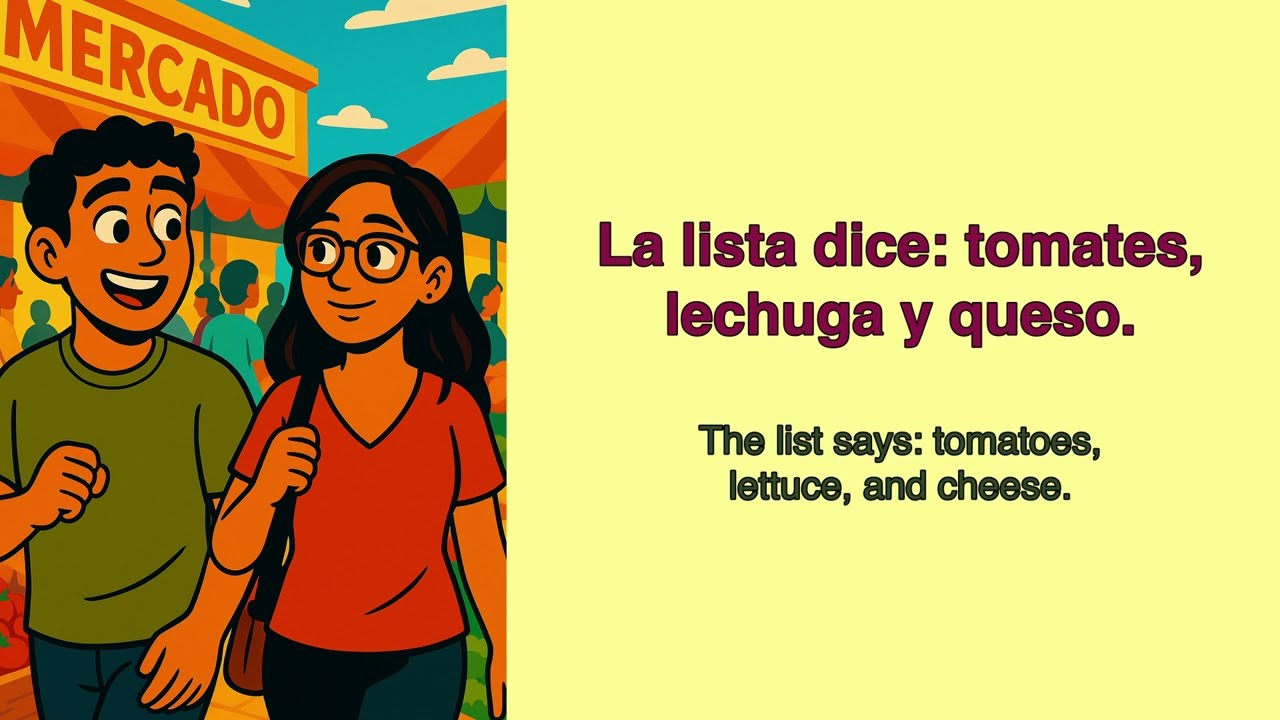
I’m Diego, and I am rushing through the market to grab fresh jitomates (red tomatoes) for María. We need quality produce by the kilo (kilogram) before my clumsy hands knock over another fruit stand. Today, you will use numbers from cien (one hundred) to mil (one thousand) and ask ¿cuánto le debo? (how much do I owe you?) at every counter.
💬 Video Transcript
Diego: ¡Hola! Soy Diego. ¿Me recuerdan? Soy el chico que busca mucho sus cosas. ¡Pero hoy estoy feliz! Encontré mi cartera. Estaba en el azúcar. ¡Qué locura!
(Diego: Hello! I’m Diego. Do you remember me? I’m the guy who is always looking for his things. But today I’m happy! I found my wallet. It was in the sugar. How crazy!)
Diego: Ahora, mi amiga María y yo vamos al mercado. Necesitamos comprar comida para la cena. El mercado es muy grande y tiene muchos colores. Hay muchas frutas y verduras. ¡Me gusta el mercado!
(Diego: Now, my friend María and I are going to the market. We need to buy food for dinner. The market is very big and has many colors. There are many fruits and vegetables. I like the market!)
Diego: María tiene la lista de la compra. La lista dice: tomates, lechuga y queso. Es una lista corta. Primero, buscamos los tomates. Yo veo unas manzanas rojas, muy, muy rojas. ¡Qué bonitas!
(Diego: María has the shopping list. The list says: tomatoes, lettuce, and cheese. It’s a short list. First, we look for the tomatoes. I see some red apples, very, very red. How pretty!)
Diego: Camino hacia las manzanas. Quiero tocar una manzana. Pero… ¡ay, no! Toco una manzana y ¡pum! Todas las manzanas se caen al suelo. ¡Muchas manzanas! El vendedor me mira. Yo estoy rojo como un tomate. ‘Lo siento, lo siento mucho’, digo.
(Diego: I walk towards the apples. I want to touch an apple. But… oh, no! I touch one apple and boom! All the apples fall to the floor. So many apples! The seller looks at me. I am red as a tomato. ‘I’m sorry, I’m very sorry,’ I say.)
Diego: María sonríe un poco. Ella me ayuda a recoger las manzanas. El vendedor es muy amable. No está enfadado. Después, compramos los tomates y buscamos la lechuga. La encontramos rápido. Es verde y fresca.
(Diego: María smiles a little. She helps me pick up the apples. The seller is very kind. He is not angry. Afterwards, we buy the tomatoes and look for the lettuce. We find it quickly. It is green and fresh.)
Diego: Ahora, solo falta el queso. Hay una tienda con muchos quesos diferentes. Veo un queso redondo y grande. Soy muy curioso. Pregunto: ‘¿Qué es ese queso?’. Levanto mi mano para señalar el queso. Pero mi mano es un poco torpe. ¡Pum! Tiro un pequeño cartel con el precio. ¡Otra vez!
(Diego: Now, only the cheese is missing. There is a shop with many different cheeses. I see a big, round cheese. I am very curious. I ask: ‘What is that cheese?’. I raise my hand to point at the cheese. But my hand is a bit clumsy. Boom! I knock over a small sign with the price. Again!)
Diego: María recoge el cartel. Ella me mira y sonríe. ‘Diego, tranquilo’, dice con calma. Finalmente, compramos todo. Tenemos los tomates, la lechuga y el queso en una bolsa. Caminamos a casa.
(Diego: María picks up the sign. She looks at me and smiles. ‘Diego, calm down,’ she says calmly. Finally, we buy everything. We have the tomatoes, the lettuce, and the cheese in a bag. We walk home.)
Diego: Yo pienso que soy muy torpe hoy. Pero María es una amiga muy buena y muy paciente. El día en el mercado es divertido con ella. Ahora, vamos a preparar una ensalada deliciosa. ¡Espero no tirar la ensalada al suelo!
(Diego: I think I am very clumsy today. But María is a very good and very patient friend. The day at the market is fun with her. Now, we are going to prepare a delicious salad. I hope I don’t drop the salad on the floor!)
📝 Essential Vocabulary
Here are some key words and phrases from Diego’s story that will help you understand his adventure at the market.
| Target Language | English Translation | Listen |
|---|---|---|
| La cartera | The wallet | |
| El mercado | The market | |
| La lista de la compra | The shopping list | |
| Las manzanas | The apples | |
| El vendedor | The seller/vendor | |
| Rojo como un tomate | Red as a tomato | |
| Torpe | Clumsy | |
| Amable | Kind | |
| Paciente | Patient | |
| La ensalada | The salad |
🔍 Grammar Focus
In this story, Diego uses many descriptive words, or adjectives. In Spanish, adjectives are a key part of making your sentences more interesting. Let’s look at one important rule: adjective agreement.
Adjective Agreement (Gender and Number)
In Spanish, adjectives must “agree” with the noun they describe. This means they change their ending to match the noun’s gender (masculine/feminine) and number (singular/plural).
Most adjectives ending in -o are masculine, and you change the -o to an -a for feminine nouns. To make them plural, you add an -s.
Let’s look at examples from the story:
- Manzanas rojas:
manzanais a feminine noun. Because there are multiple apples, it’s plural (manzanas). The adjectiverojo(red) must also become feminine and plural: rojas. - Una lista corta:
listais a feminine, singular noun. The adjectivecorto(short) changes to corta to match. - Un queso redondo y grande:
quesois a masculine, singular noun. The adjectivesredondo(round) andgrande(big) match it. Note that adjectives ending in -e likegrandeoften don’t change for gender. - Una amiga… buena y… paciente:
amigais feminine and singular. The adjectives must match: buena andpaciente.
Paying attention to these endings will make your Spanish sound much more natural!
🃏 Flip & Learn
Use these flashcards to test your memory of key phrases and vocabulary from the story.
💡 Key Takeaways
Here are the most important points to remember from Diego’s market adventure:
- Market Vocabulary: You learned essential words for shopping, like
el mercado(market),la lista de la compra(shopping list),el vendedor(seller), and names of food items likemanzanas,tomates,lechuga, andqueso. - Describing People: You can now describe people using adjectives like
torpe(clumsy),amable(kind), andpaciente(patient). - Expressing Embarrassment: The idiom
estar rojo como un tomate(to be red as a tomato) is a very common and natural way to say you are embarrassed. - Adjective Agreement is Key: Remember that in Spanish, adjectives must change their endings to match the gender (masculine/feminine) and number (singular/plural) of the nouns they describe, like in manzanas rojas and lista corta.
🎯 Practice Quiz
Let’s check what you’ve learned. Choose the best answer for each question.
Quick check
Quick check
Quick check
✍️ Fill in the Blanks
Let’s test your spelling and memory! Fill in the missing words below. Use correct spelling.
Fill in the blank
Fill in the blank


Back PandaTwin
María here! We're building this course a lesson at a time, and your support is what keeps it moving.


