Talking About Food and Daily Routines in Russian: Misha the Bear's Story 🐻
Learn essential Russian vocabulary for daily routines and food by following the story of Misha, a retired circus bear, on his delicious quest for his favorite pirozhki.
Join Misha, a friendly retired circus bear, on his heartwarming adventure to get his favorite food: delicious, homemade pirozhki! This simple story is perfect for beginners to practice Russian vocabulary related to daily routines, food, and simple greetings. You’ll learn how to express what you want and describe a simple, happy day.
💬 Video Transcript
Misha: Здравствуйте! Меня зовут Миша. Да, я медведь.
(Misha: Hello! My name is Misha. Yes, I am a bear.)
Misha: Раньше я работал в цирке. Я умею танцевать и махать лапой.
(Misha: I used to work in a circus. I know how to dance and wave my paw.)
Misha: Но сейчас я на пенсии. Я живу в лесу, рядом с домом, где живёт Бабушка.
(Misha: But now I am retired. I live in the forest, near the house where Babushka lives.)
Misha: Утро. Солнце светит. Я просыпаюсь и делаю зарядку. Один, два, три, четыре. Как в цирке.
(Misha: Morning. The sun is shining. I wake up and do my exercises. One, two, three, four. Just like in the circus.)
Misha: Потом я думаю. Что я хочу сегодня? Ответ простой. Я хочу пирожки!
(Misha: Then I think. What do I want today? The answer is simple. I want pirozhki!)
Misha: Бабушка делает самые вкусные пирожки. Я иду к её дому.
(Misha: Babushka makes the most delicious pirozhki. I go to her house.)
Misha: Дом небольшой, но очень уютный. Вокруг дома красивый сад.
(Misha: The house is not big, but very cozy. Around the house is a beautiful garden.)
Misha: Я вижу Бабушку. Она поливает цветы. Я тихо подхожу и машу ей лапой.
(Misha: I see Babushka. She is watering the flowers. I quietly approach and wave my paw to her.)
Babushka: Миша! Привет, мой хороший!
(Babushka: Misha! Hello, my dear!)
Misha: Я очень рад. Она идёт в дом и возвращается с тарелкой.
(Misha: I am very happy. She goes into the house and returns with a plate.)
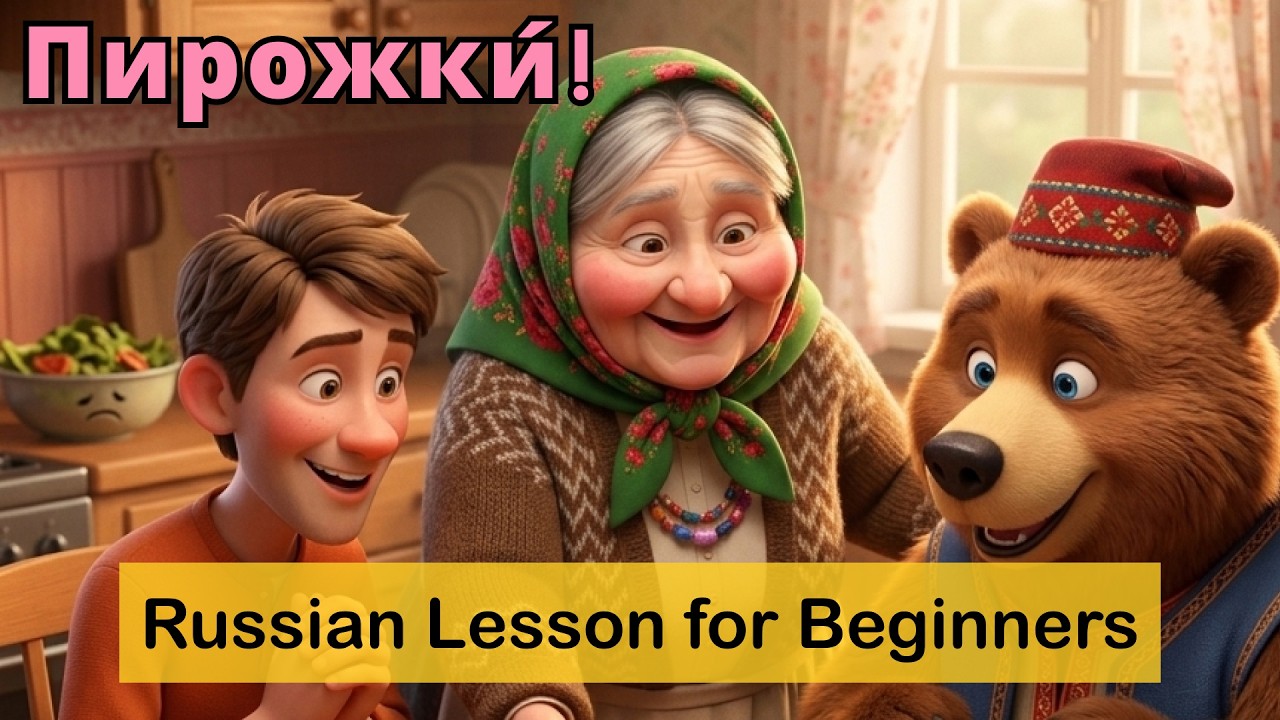
Misha: На тарелке лежат тёплые, ароматные пирожки. Один с картошкой, другой с капустой. Мои любимые!
(Misha: On the plate are warm, fragrant pirozhki. One with potato, the other with cabbage. My favorites!)
Misha: Я аккуратно беру один пирожок. Он очень вкусный. Я сижу на траве и ем.
(Misha: I carefully take one pirozhok. It is very delicious. I sit on the grass and eat.)
Misha: В это время из дома выходит Иван. Он видит меня и тоже улыбается.
(Misha: At this time, Ivan comes out of the house. He sees me and also smiles.)
Ivan: Привет, Миша! Приятного аппетита!
(Ivan: Hello, Misha! Enjoy your meal!)
Misha: Рядом с ним его серый кот, Борис. Борис смотрит на меня, зевает и ложится спать прямо на солнце. Он очень ленивый.
(Misha: Next to him is his gray cat, Boris. Boris looks at me, yawns, and lies down to sleep right in the sun. He is very lazy.)
Misha: Я съел все пирожки. Я очень доволен.
(Misha: I ate all the pirozhki. I am very satisfied.)
Misha: Я подхожу к Бабушке и обнимаю её. Это моё ‘спасибо’. Она гладит меня по голове.
(Misha: I go to Babushka and hug her. This is my ’thank you’. She strokes my head.)
Misha: Теперь я сыт и счастлив. Я иду обратно в лес, чтобы отдохнуть. Это был очень хороший день.
(Misha: Now I am full and happy. I am going back to the forest to rest. It was a very good day.)
📝 Essential Vocabulary
Here are some of the key words and phrases you’ll hear in Misha’s story. Listen and repeat to practice your pronunciation.
| Target Language | English Translation | Pronunciation |
|---|---|---|
| медведь | bear | |
| пирожки | small pies | |
| утро | morning | |
| делать зарядку | to do exercises | |
| я хочу | I want | |
| вкусный | delicious, tasty | |
| ленивый | lazy | |
| приятного аппетита | enjoy your meal |
🔍 Grammar Focus
Let’s look at two simple but important grammar patterns from Misha’s story.
1. Simple Present Tense Verbs
The entire story is told in the present tense, which is great for describing daily actions. Notice how many verbs Misha uses that end in -ю or -у when he talks about himself (“I”). This is a common pattern for “I” verbs in Russian.
- Я живу в лесу. (I live in the forest.)
- Я просыпаюсь и делаю зарядку. (I wake up and do my exercises.)
- Я думаю. (I think.)
- Я иду к её дому. (I am going to her house.)
2. Expressing “I want” with Я хочу
One of the most useful phrases for any beginner is how to say what you want. Misha makes it very clear! The verb “to want” in Russian is хотеть (khotet’). When you are talking about yourself, you use the form хочу (khochu). You can simply follow it with the noun (the thing you want).
Что **я хочу** сегодня?(What do I want today?)**Я хочу** пирожки!(I want pirozhki!)
🌍 Cultural Tip
🃏 Flip & Learn
Use these flashcards to test your memory of key phrases from the story.
I am a bear
Я медведь
I want pirozhki!
Я хочу пирожки!
He is very lazy
Он очень ленивый
Enjoy your meal!
Приятного аппетита!
💡 Key Takeaways
Here are the most important points to remember from this lesson:
- Introducing Yourself: You can introduce yourself using the phrase
Меня зовут...(My name is…). - Expressing Wants: To say “I want something,” use the simple pattern
Я хочу+ [noun]. For example,Я хочу пирожки. - Daily Routine Verbs: You learned several verbs for daily actions:
просыпаюсь(I wake up),делаю зарядку(I do exercises),живу(I live), andем(I eat). - Polite Phrases: Remember these useful expressions:
Здравствуйте(Hello - formal),Привет(Hi - informal), andПриятного аппетита(Enjoy your meal).
🎯 Practice Quiz
Check your understanding with a few questions about Misha’s day.
Question
Question
Question
✍️ Fill in the Blanks
Let’s test your spelling and memory! Fill in the missing words below. Use correct spelling.
Fill in the blank
Fill in the blank
Support Us
Did you find this lesson helpful? Your support is what makes it possible for us to keep creating free, high-quality educational content.