Talking About Colors in Portuguese: Home Decor Decisions 🎨
Learn how to discuss colors, express personal preferences, and make simple decisions in Portuguese through a fun home decoration dialogue.
In this lesson, you will learn how to discuss colors and express your personal preferences in Portuguese while following João and Sofia’s fun room decoration project. You’ll master essential vocabulary for household items, learn to state what you like and prefer, and see how to come to a shared agreement.
💬 Video Transcript (Transcrição do Vídeo)
João: Sofia, olha para esta parede na nossa sala.
(João: Sofia, look at this wall in our living room.)
Sofia: Sim, João. Eu estou a olhar para a parede.
(Sofia: Yes, João. I am looking at the wall.)
João: A parede é muito branca. Eu acho que é uma parede aborrecida.
(João: The wall is very white. I think it is a boring wall.)
Sofia: Uma parede aborrecida? Sim, é verdade. A parede é só branca.
(Sofia: A boring wall? Yes, it’s true. The wall is just white.)
João: Muito, muito branca. Precisamos de uma cor.
(João: Very, very white. We need a color.)
Sofia: Uma cor! Que boa ideia, João! Vamos pintar a parede.
(Sofia: A color! What a good idea, João! Let’s paint the wall.)
João: Pintar a parede? Sim! Eu gosto muito dessa ideia. Vamos pintar!
(João: Paint the wall? Yes! I really like that idea. Let’s paint!)
Sofia: Ótimo! Que cor tu queres?
(Sofia: Great! What color do you want?)
João: Hum, eu não sei. Talvez… azul? Eu gosto de azul.
(João: Hmm, I don’t know. Maybe… blue? I like blue.)
Sofia: Azul é uma cor bonita. Mas eu gosto de amarelo. Amarelo é a minha cor favorita.
(Sofia: Blue is a pretty color. But I like yellow. Yellow is my favorite color.)
João: Eu gosto de amarelo, mas eu prefiro azul para a sala. Azul é calmo.
(João: I like yellow, but I prefer blue for the living room. Blue is calm.)
Sofia: E amarelo é alegre! Eu quero amarelo.
(Sofia: And yellow is cheerful! I want yellow.)
João: E eu quero azul. Hmm… isto é um problema.
(João: And I want blue. Hmm… this is a problem.)
Sofia: Eu quero pintar de amarelo. Tu queres pintar de azul.
(Sofia: I want to paint yellow. You want to paint blue.)
João: Sim. O que vamos fazer?
(João: Yes. What are we going to do?)
Sofia: Espera! Tenho uma ideia! Uma ideia muito boa!
(Sofia: Wait! I have an idea! A very good idea!)
João: Outra ideia? Qual é?
(João: Another idea? What is it?)
Sofia: O que acontece quando misturamos azul e amarelo?
(Sofia: What happens when we mix blue and yellow?)
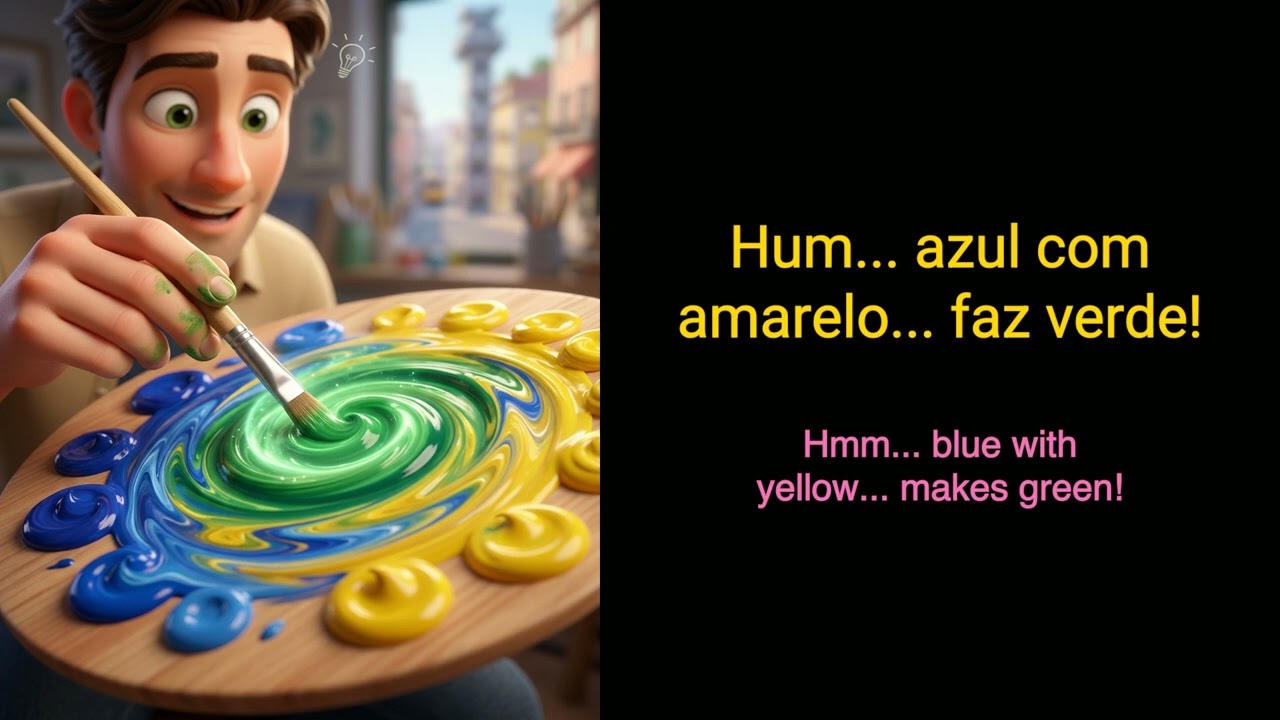
João: Azul e amarelo? Hum… azul com amarelo… faz verde!
(João: Blue and yellow? Hmm… blue with yellow… makes green!)
Sofia: Exato! Verde! Podemos pintar a parede de verde!
(Sofia: Exactly! Green! We can paint the wall green!)
João: Verde! Sofia, é uma ideia excelente! Eu adoro verde!
(João: Green! Sofia, it’s an excellent idea! I love green!)
Sofia: Eu também adoro verde! Verde é uma cor perfeita! É uma cor calma e alegre!
(Sofia: I also love green! Green is a perfect color! It is a calm and cheerful color!)
João: Sim! A nossa sala vai ser verde! Vai ficar muito bonita.
(João: Yes! Our living room will be green! It will look very pretty.)
Sofia: Sim, vai ficar linda! Então, está decidido. Pintamos a parede de verde.
(Sofia: Yes, it will look beautiful! So, it’s decided. We paint the wall green.)
João: Perfeito. O que precisamos para pintar?
(João: Perfect. What do we need to paint?)
Sofia: Precisamos de tinta. Muita tinta verde.
(Sofia: We need paint. A lot of green paint.)
João: Certo. Tinta verde. E precisamos de um pincel para mim e um pincel para ti.
(João: Right. Green paint. And we need a brush for me and a brush for you.)
Sofia: Sim, dois pincéis. Tinta verde e dois pincéis. Vamos à loja agora?
(Sofia: Yes, two brushes. Green paint and two brushes. Shall we go to the store now?)
João: Sim, vamos à loja agora. Estou muito animado para começar.
(João: Yes, let’s go to the store now. I am very excited to start.)
Sofia: Eu também! A nossa sala vai ter uma cor nova!
(Sofia: Me too! Our living room will have a new color!)
João: E depois de pintar, como recompensa…
(João: And after painting, as a reward…)
Sofia: Já sei! Depois, vamos comer um pastel de nata!
(Sofia: I know! Afterwards, let’s eat a custard tart!)
João: Exatamente! Um pastel de nata para celebrar a nossa parede verde!
(João: Exactly! A custard tart to celebrate our green wall!)
Sofia: Perfeito! Vamos à loja!
(Sofia: Perfect! Let’s go to the store!)
📝 Essential Vocabulary (Vocabulário Essencial)
| Target Language | English Translation | Pronunciation |
|---|---|---|
| a parede | the wall | |
| aborrecido | boring | |
| pintar | to paint | |
| azul | blue | |
| amarelo | yellow | |
| verde | green | |
| a tinta | the paint | |
| o pincel | the brush | |
| a loja | the store | |
| o pastel de nata | the custard tart |
🔍 Grammar Focus (Foco Gramatical)
Gender Agreement with Adjectives
In Portuguese, adjectives must agree in gender (masculine or feminine) with the noun they describe. Words that end in “-o” are typically masculine, while words ending in “-a” are generally feminine.
Notice how João and Sofia use adjectives to describe the wall:
- “A parede é muito branca.” (The wall is very white.)
- “Uma parede aborrecida.” (A boring wall.)
Since parede (wall) is a feminine noun, the adjectives branca and aborrecida end with an -a.
Expressing Likes and Preferences
When you want to say you like something in Portuguese, you use the verb gostar followed by the preposition de.
- “Eu gosto de azul.” (I like blue.)
- “Eu gosto muito dessa ideia.” (I really like that idea.) Note: dessa is a contraction of de + essa.
When expressing a direct preference, you use the verb preferir. Unlike gostar, preferir does not require the preposition de:
- “Eu prefiro azul para a sala.” (I prefer blue for the living room.)
🌍 Cultural Tip (Dica Cultural)
🃏 Flip & Learn (Vire e Aprenda)
the wall
a parede
boring
aborrecido
to paint
pintar
the paint
a tinta
the brush
o pincel
💡 Key Takeaways (Principais Aprendizados)
- Adjectives must always match the gender of the noun they modify (e.g., a parede branca, a parede aborrecida).
- To say you like something, always use the verb gostar with the preposition de (e.g., gosto de amarelo).
- To state a specific preference without using gostar, simply use the verb preferir (e.g., prefiro azul).
- When making a suggestion, vamos + [infinitive verb] is a great structure to use (e.g., Vamos pintar a parede! - Let’s paint the wall!).
🎯 Practice Quiz (Quiz de Prática)
Question
Question
Question
✍️ Fill in the Blanks (Preencha as Lacunas)
Let’s test your spelling and memory! Fill in the missing words below. Use correct spelling.
Fill in the blank
Fill in the blank
Support Us
Did you find this lesson helpful? Your support is what makes it possible for us to keep creating free, high-quality educational content.