Studying at the Library in Korean: Essential Vocabulary & Dialogue 📚
Learn essential beginner Korean vocabulary for places like the library and restaurant. Follow along with our dialogue about studying, books, and getting hungry!
In this beginner Korean lesson, you’ll join Minjun and Seoyeon on their study adventure at the library. You’ll learn essential vocabulary for places and objects, how to talk about what you’re studying, and how to suggest getting food when you’re hungry.
💬 Video Transcript
민준: 서연! 여기예요! 토요일이에요!
(Minjun: Seoyeon! Over here! It’s Saturday!)
서연: 아, 민준! 안녕하세요. 네, 토요일 오후예요.
(Seoyeon: Ah, Minjun! Hello. Yes, it’s Saturday afternoon.)
민준: 우리 약속이 있어요. 도서관 약속이요.
(Minjun: We have a plan. A library plan.)
서연: 맞아요. 도서관에 가요. 같이 가요.
(Seoyeon: That’s right. We’re going to the library. Let’s go together.)
민준: 좋아요! 지금 도서관에 들어가요.
(Minjun: Okay! Let’s go into the library now.)
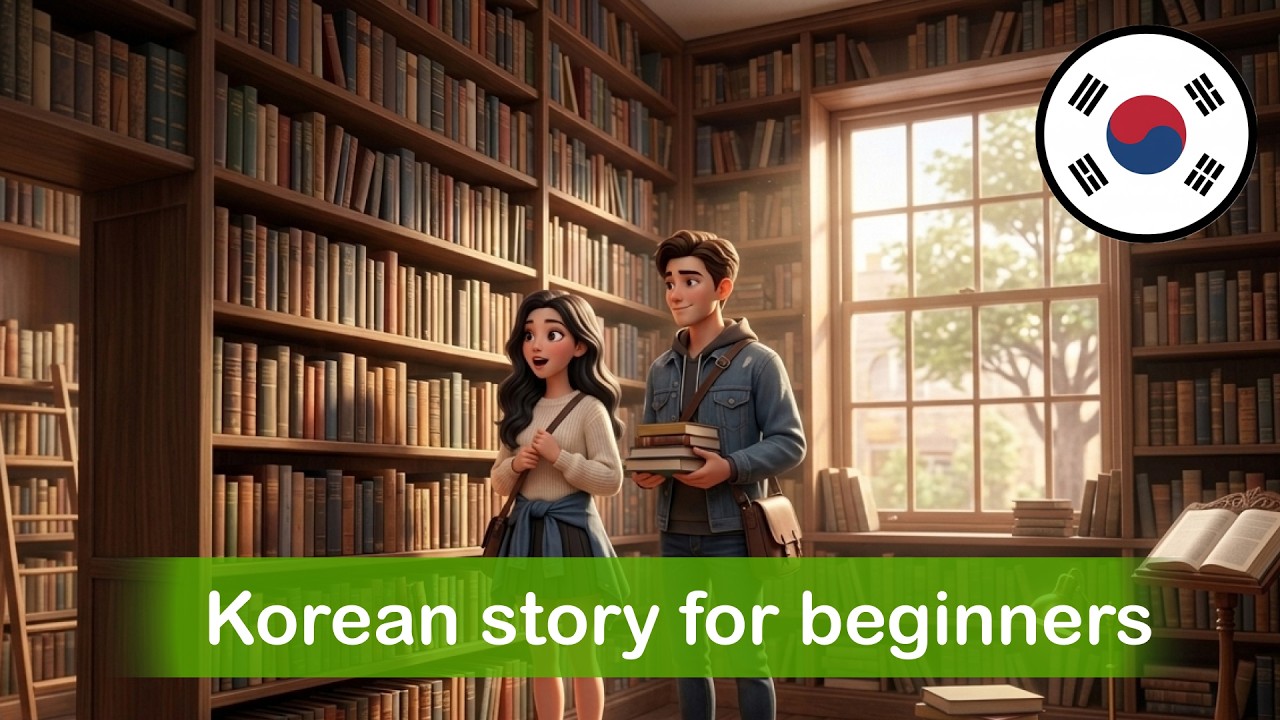
(민준과 서연이 도서관 안으로 들어간다)
(Minjun and Seoyeon go inside the library)
서연: 와… 도서관이 정말 커요.
(Seoyeon: Wow… the library is really big.)
민준: 네, 아주 커요. 그리고 책이 정말 많아요.
(Minjun: Yes, it’s very big. And there are so many books.)
서연: 맞아요. 책이 여기에도 있고, 저기에도 있어요.
(Seoyeon: That’s right. There are books here, and there are books there.)
민준: 책이 아주, 아주 많아요. 서연은 뭐 해요?
(Minjun: There are very, very many books. Seoyeon, what are you doing?)
서연: 저는 한국어를 공부해요. 한국어 책을 읽어요.
(Seoyeon: I’m studying Korean. I’m reading a Korean book.)
민준: 아, 한국어 공부! 좋아요. 재미있어요?
(Minjun: Ah, studying Korean! Nice. Is it fun?)
서연: 네, 아주 재미있어요. 민준은 무슨 책을 읽어요?
(Seoyeon: Yes, it’s very fun. Minjun, what kind of book are you reading?)
민준: 저는… 재미있는 책을 읽어요. 그림이 많은 책이 좋아요.
(Minjun: I’m… reading a fun book. I like books with a lot of pictures.)
서연: 아, 그림책이요. 좋아요. 그럼, 우리 같이 공부해요?
(Seoyeon: Ah, a picture book. Nice. Then, shall we study together?)
민준: 같이요? 네, 좋아요! 같이 한국어 공부해요.
(Minjun: Together? Yes, okay! Let’s study Korean together.)
(두 사람이 책상에 앉는다)
(The two sit at a desk)
서연: 자, 여기 책상 위에 책이 있어요.
(Seoyeon: Okay, there is a book here on the desk.)
민준: 네, 책이 있어요. 그리고 펜이 있어요.
(Minjun: Yes, there is a book. And there is a pen.)
서연: 맞아요. 책하고 펜이 있어요. 우리는 공부해요.
(Seoyeon: That’s right. There is a book and a pen. We are studying.)
민준: 네, 우리는 한국어를 공부해요.
(Minjun: Yes, we are studying Korean.)
서연: 공부는 재미있어요.
(Seoyeon: Studying is fun.)
민준: 네, 재미있어요. 하지만… 저는 조금 배고파요.
(Minjun: Yes, it’s fun. But… I’m a little hungry.)
서연: 어? 배고파요? 저도 조금 배고파요.
(Seoyeon: Oh? You’re hungry? I’m a little hungry too.)
민준: 그럼 우리 밥 먹어요? 도서관 공부는 끝!
(Minjun: Then shall we eat? Library studying is finished!)
서연: 좋아요! 밥 먹어요. 뭐 먹어요?
(Seoyeon: Okay! Let’s eat. What should we eat?)
민준: 저기 식당이 있어요. 도서관 앞에 식당이 있어요.
(Minjun: There’s a restaurant over there. There’s a restaurant in front of the library.)
서연: 정말요? 좋아요! 식당에 가요.
(Seoyeon: Really? Okay! Let’s go to the restaurant.)
민준: 네! 우리 같이 밥 먹으러 가요.
(Minjun: Yes! Let’s go eat together.)
📝 Essential Vocabulary
Here are some key words and phrases from the video. Listen to the pronunciation and practice saying them out loud.
| Target Language | English Translation | Pronunciation |
|---|---|---|
| 도서관 (doseogwan) | Library | |
| 책 (chaek) | Book | |
| 공부해요 (gongbuhaeyo) | To study | |
| 재미있어요 (jaemiisseoyo) | It’s interesting / fun | |
| 같이 (gachi) | Together | |
| 배고파요 (baegopayo) | I’m hungry | |
| 식당 (sikdang) | Restaurant | |
| 약속 (yaksok) | Promise / Appointment |
🔍 Grammar Focus
Let’s break down two important grammar points from the dialogue.
1. The Location Particle: 에 (e)
In Korean, the particle 에 is attached to nouns to indicate a location or a destination. You saw it used many times in the video.
Indicating a static location (where something is):
- 책이 여기에도 있고, 저기에도 있어요. (There are books here, and there are books there.)
- 책상 위에 책이 있어요. (There is a book on the desk.)
- 도서관 앞에 식당이 있어요. (There is a restaurant in front of the library.)
Indicating a destination (where someone is going):
- 도서관에 가요. (Let’s go to the library.)
- 식당에 가요. (Let’s go to the restaurant.)
Notice how 에 helps clarify the relationship between the noun (like “library”) and the verb (like “go” or “is”).
2. Polite Present Tense: -아요 / -어요 (-ayo / -eoyo)
Almost every verb in this dialogue ends in -아요 or -어요. This is the standard polite way to conjugate verbs in the present tense in Korean. The one you use depends on the last vowel of the verb stem.
If the last vowel of the verb stem is ㅏ or ㅗ, you add -아요.
- 많다 (to be many) → 많 + 아요 → 많아요.
- 좋다 (to be good) → 좋 + 아요 → 좋아요.
If the last vowel is anything else (ㅓ, ㅜ, ㅣ, etc.), you add -어요.
- 있다 (to exist/have) → 있 + 어요 → 있어요.
- 먹다 (to eat) → 먹 + 어요 → 먹어요.
For verbs ending in 하다 (hada), they become -해요 (haeyo).
- 공부하다 (to study) → 공부해요.
This is a fundamental rule for speaking Korean, and this dialogue is full of great examples!
🌍 Cultural Tip
🃏 Flip & Learn
Use these flashcards to test your memory of key vocabulary from the lesson.
Library
도서관
I'm hungry
배고파요
To study
공부해요
Together
같이
Restaurant
식당
💡 Key Takeaways
Here are the most important points to remember from this lesson:
- Use the particle
에to mark a location (도서관에 있어요- I’m at the library) or a destination (식당에 가요- Let’s go to the restaurant). - The standard polite present tense verb ending is
-아요or-어요. You can see this in common phrases like있어요(there is),먹어요(to eat), and재미있어요(it’s fun). - To say you are hungry, you can use the expression
배고파요(baegopayo). - To suggest an activity together, you can state the verb and add a question mark, like
우리 밥 먹어요?(Shall we eat?).
🎯 Practice Quiz
Check your understanding with these questions based on the video.
Question
Question
Question
✍️ Fill in the Blanks
Let’s test your spelling and memory! Fill in the missing words below. Use correct spelling.
Fill in the blank
Fill in the blank
Support Us
Did you find this lesson helpful? Your support is what makes it possible for us to keep creating free, high-quality educational content.