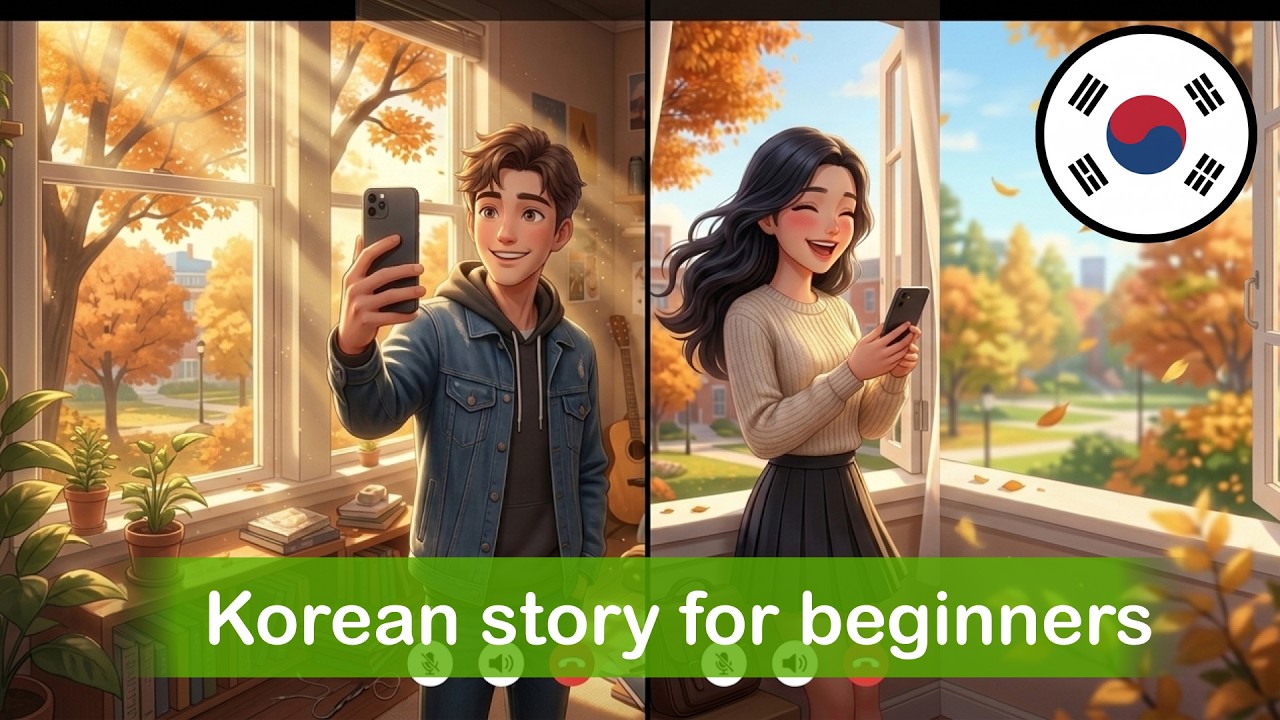
Talking About Music in Korean: Music Vocabulary & Park Dialogue 🎵
Learn how to talk about your favorite music in Korean! This A1 beginner lesson covers key vocabulary for K-pop, ballads, and expressing your musical tastes.
Join Minjun and Seoyeon in the park as they share headphones and listen to music. This beginner Korean dialogue is perfect for learning how to express your musical preferences, describe songs as exciting or quiet, and ask about different artists. You’ll master key vocabulary and grammar for everyday conversations.
💬 Video Transcript
민준: 서연, 안녕! 여기서 뭐 해요?
(Minjun: Seoyeon, hi! What are you doing here?)
서연: 어, 민준! 안녕! 나는 공원에 앉아 있어요.
(Seoyeon: Oh, Minjun! Hi! I’m sitting in the park.)
민준: 공원이 정말 좋아요. 날씨도 좋아요.
(Minjun: The park is really nice. The weather is nice too.)
서연: 맞아요. 날씨가 아주 좋아요. 그래서 음악을 들어요.
(Seoyeon: That’s right. The weather is very good. So I’m listening to music.)
민준: 음악을 들어요? 지금요?
(Minjun: You’re listening to music? Right now?)
서연: 네, 지금 음악을 들어요. 민준도 음악 좋아해요?
(Seoyeon: Yes, I’m listening to music now. Do you like music too, Minjun?)
민준: 네! 저도 음악 정말 좋아해요. 무슨 음악 들어요?
(Minjun: Yes! I really like music too. What music are you listening to?)
서연: 음… K-pop을 들어요. 이 노래 정말 좋아요.
(Seoyeon: Hmm… I’m listening to K-pop. This song is really good.)
민준: 와, K-pop! 저도 K-pop 좋아해요. 같이 들어요!
(Minjun: Wow, K-pop! I like K-pop too. Let’s listen together!)
서연: 좋아요! 자, 여기요. 같이 들어요.
(Seoyeon: Okay! Here you go. Let’s listen together.)
민준: 고마워요. … 와, 이 노래 신나요. 정말 신나요.
(Minjun: Thanks. … Wow, this song is exciting. It’s really exciting.)
서연: 그렇죠? 이 노래는 아주 신나요. 가수가 누구예요?
(Seoyeon: Right? This song is very exciting. Who is the singer?)
민준: 음… 잘 모르겠어요. 가수가 누구예요?
(Minjun: Hmm… I don’t know well. Who is the singer?)
서연: 이 가수는 ‘스타’예요. ‘스타’를 알아요?
(Seoyeon: This singer is ‘Star’. Do you know ‘Star’?)
민준: 아니요, 몰라요. 하지만 목소리가 정말 좋아요.
(Minjun: No, I don’t know them. But their voice is really good.)
서연: 맞아요. 목소리가 예뻐요. 자, 다음 노래예요.
(Seoyeon: That’s right. The voice is pretty. Okay, it’s the next song.)
민준: 오, 노래가 바뀌었어요. 이 노래는 조용해요.
(Minjun: Oh, the song changed. This song is quiet.)
서연: 네. 이 노래는 발라드예요. 조용한 노래예요.
(Seoyeon: Yes. This song is a ballad. It’s a quiet song.)
민준: 아, 발라드. 이 노래도 좋아요. 마음이 편안해요.
(Minjun: Ah, a ballad. I like this song too. My heart feels at ease.)
서연: 민준은 신나는 노래가 좋아요? 조용한 노래가 좋아요?
(Seoyeon: Minjun, do you like exciting songs or quiet songs?)
민준: 음… 저는 신나는 노래가 더 좋아요. 춤을 추고 싶어요!
(Minjun: Hmm… I like exciting songs more. I want to dance!)
서연: 하하하. 저는 조용한 노래가 더 좋아요. 책을 읽고 싶어요.
(Seoyeon: Hahaha. I like quiet songs more. I want to read a book.)
민준: 우리는 조금 달라요. 하지만 둘 다 음악을 좋아해요.
(Minjun: We are a little different. But we both like music.)
서연: 맞아요. 그게 중요해요. 우리는 음악을 아주 좋아해요.
(Seoyeon: That’s right. That’s what’s important. We really like music.)
민준: 서연, 또 다른 노래 있어요?
(Minjun: Seoyeon, are there other songs?)
서연: 네, 많이 있어요. 이 노래는 어때요? 들어보세요.
(Seoyeon: Yes, there are many. How about this song? Have a listen.)
민준: 와! 이 노래도 알아요! 제가 아주 좋아하는 노래예요.
(Minjun: Wow! I know this song too! It’s a song I really like.)
서연: 정말요? 와, 잘됐다! 그럼 이 노래 같이 들어요.
(Seoyeon: Really? Wow, that’s great! Then let’s listen to this song together.)
민준: 네! 좋아요. 같이 노래 들어요. 오늘 정말 재미있어요.
(Minjun: Yes! Okay. Let’s listen to the song together. Today is really fun.)
서연: 저도요. 민준하고 같이 음악을 들어요. 그래서 더 재미있어요.
(Seoyeon: Me too. I’m listening to music with Minjun. So it’s more fun.)
📝 Essential Vocabulary
Here are some important words and phrases from the video. Practice your pronunciation with the audio clips!
| Korean | English Translation | Pronunciation |
|---|---|---|
| 음악 | Music | |
| 듣다 | To listen | |
| 노래 | Song | |
| 같이 | Together | |
| 신나다 | To be exciting/upbeat | |
| 조용하다 | To be quiet/calm | |
| 가수 | Singer | |
| 목소리 | Voice | |
| 좋아하다 | To like | |
| 모르다 | To not know |
🔍 Grammar Focus
This conversation uses two fundamental Korean grammar patterns: the present tense verb ending and particles for comparing topics.
1. Present Tense: -아요/어요
This is the standard, polite way to conjugate verbs and adjectives in the present tense in Korean. The ending you use depends on the last vowel of the verb stem.
If the last vowel is ㅏ or ㅗ, you add
-아요.- 좋다 (to be good) → 좋 +
아요→ 좋아요 - 알다 (to know) → 알 +
아요→ 알아요
- 좋다 (to be good) → 좋 +
If the last vowel is anything else (ㅓ, ㅜ, ㅣ, etc.), you add
-어요.- 듣다 (to listen) → 들 +
어요→ 들어요 (Note:ㄷirregular verb) - 있다 (to exist) → 있 +
어요→ 있어요
- 듣다 (to listen) → 들 +
If the stem ends in 하다 (to do), it becomes 해요.
- 조용하다 (to be quiet) → 조용해요
- 뭐 하다 (to do what) → 뭐 해요?
You can see this pattern throughout the script: “음악을 들어요”, “K-pop 좋아해요”, “노래가 신나요”.
2. Topic (-은/는) vs. Subject (-이/가) Particles
Korean uses particles to mark the function of a noun in a sentence. -이/가 marks the subject, while -은/는 marks the topic, often for comparison or contrast.
Notice Seoyeon’s question and Minjun’s answer:
서연: 민준은 신나는 노래가 좋아요? 조용한 노래가 좋아요? (Seoyeon: As for you, Minjun, are exciting songs good? Or are quiet songs good?)
민준: 저는 신나는 노래가 더 좋아요. (Minjun: As for me, I like exciting songs more.)
Here, 민준은 and 저는 use -은/는 to set “Minjun” and “I” as the main topic of the sentence. In contrast, 노래가 uses -이/가 to mark “songs” as the subject of the verb “to be good” (좋아요). This structure is very common when expressing opinions or comparing preferences.
🌍 Cultural Tip
🃏 Flip & Learn
Use these flashcards to test your knowledge of key phrases from the dialogue.
To listen to music
음악을 들어요
This song is exciting
이 노래는 신나요
Who is the singer?
가수가 누구예요?
Let's listen together
같이 들어요
Do you like quiet songs?
조용한 노래가 좋아요?
💡 Key Takeaways
Here are the most important points to remember from this lesson:
- To say you are listening to music, you can use the phrase 음악을 들어요.
- You can describe music as 신나요 (exciting/upbeat) or 조용해요 (quiet/calm).
- To ask “what kind of…” you can use 무슨. For example, 무슨 음악 들어요? (What music are you listening to?).
- To suggest doing something together, add 같이 before a verb conjugated with
-아요/어요. For example, 같이 들어요! (Let’s listen together!). - Use the
Topic Marker (-은/는)+Subject Marker (-이/가)pattern to state preferences: 저는 [Noun]가 좋아요 (As for me, I like [Noun]).
🎯 Practice Quiz
Check your understanding with a few questions based on the lesson.
Question
Question
Question
✍️ Fill in the Blanks
Let’s test your spelling and memory! Fill in the missing words below. Use correct spelling.
Fill in the blank
Fill in the blank
Support Us
Did you find this lesson helpful? Your support is what makes it possible for us to keep creating free, high-quality educational content.