
Counting and Describing Objects in Hindi: Classroom Tour & Vocabulary 🏫
Learn basic Hindi classroom vocabulary and how to count from 1 to 5. Follow Aarav and Priya as they explore her school in this slow Hindi dialogue for A1 beginners.
- Video 60 of 70 in this unit
- Beginner · A1 — First words, greetings, and basic phrases
- Explore — extra practice and context, on Explore and Immersion
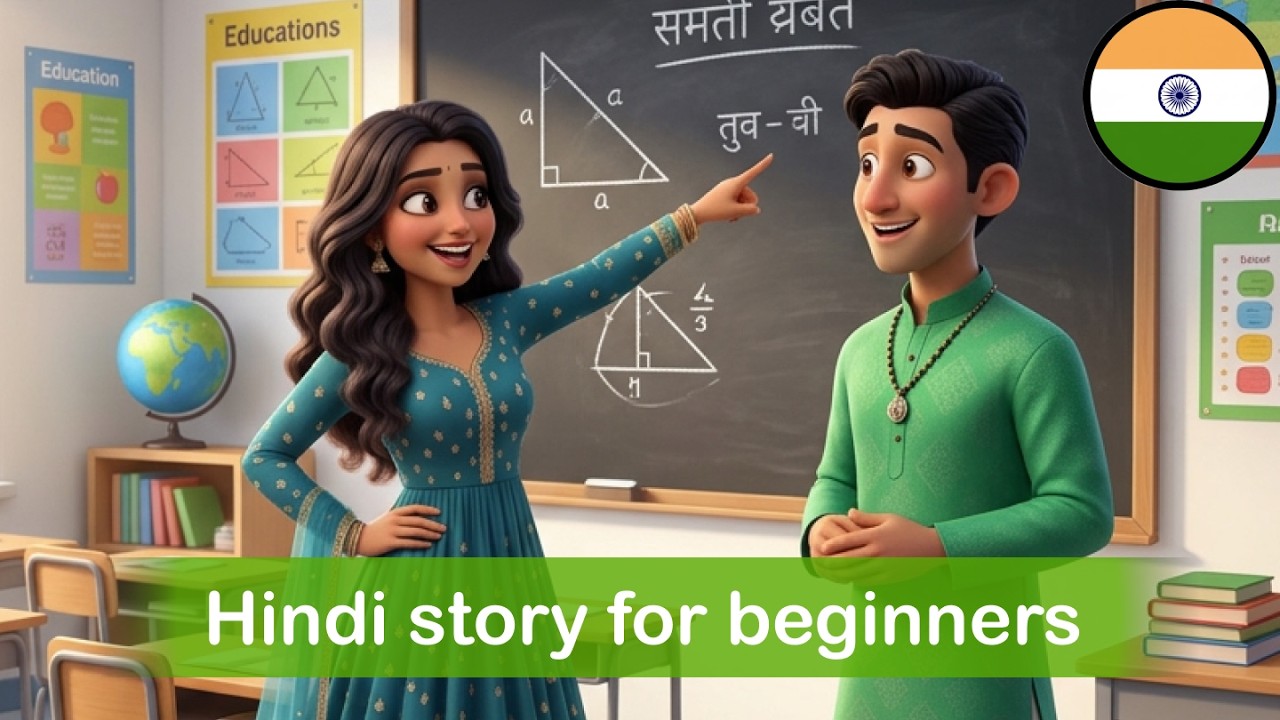
In this beginner Hindi lesson, you’ll join Aarav as he gets a tour of Priya’s school and classroom. You will learn essential vocabulary for objects in a classroom, how to describe them, and practice counting from one to five in Hindi.
💬 Video Transcript
आरव: नमस्ते प्रिया! तुम कैसी हो?
(Aarav: Hello Priya! How are you?)
प्रिया: नमस्ते आरव! मैं ठीक हूँ। तुम कैसे हो?
(Priya: Hello Aarav! I am fine. How are you?)
आरव: मैं भी ठीक हूँ। यह कौन सी जगह है?
(Aarav: I am also fine. What place is this?)
प्रिया: आरव, यह मेरा स्कूल है।
(Priya: Aarav, this is my school.)
आरव: वाह! तुम्हारा स्कूल बहुत बड़ा है।
(Aarav: Wow! Your school is very big.)
प्रिया: धन्यवाद। चलो, अंदर आओ। यह मेरी कक्षा है।
(Priya: Thank you. Come on, come inside. This is my classroom.)
आरव: तुम्हारी कक्षा बहुत अच्छी है, प्रिया।
(Aarav: Your classroom is very nice, Priya.)
प्रिया: हाँ, यह मेरी कक्षा है। देखो, वह एक श्यामपट्ट है।
(Priya: Yes, this is my classroom. Look, that is a blackboard.)
आरव: श्यामपट्ट का रंग काला है।
(Aarav: The blackboard’s color is black.)
प्रिया: हाँ, श्यामपट्ट का रंग काला है।
(Priya: Yes, the blackboard’s color is black.)
आरव: और यह क्या है?
(Aarav: And what is this?)
प्रिया: यह मेरी मेज़ है।
(Priya: This is my desk.)
आरव: तुम्हारी मेज़ अच्छी है। और वे क्या हैं?
(Aarav: Your desk is nice. And what are those?)
प्रिया: वे कुर्सियाँ हैं।
(Priya: Those are chairs.)
आरव: यहाँ कितनी कुर्सियाँ हैं?
(Aarav: How many chairs are here?)
प्रिया: मुझे नहीं पता। चलो गिनते हैं।
(Priya: I don’t know. Let’s count.)
आरव: ठीक है। एक… दो…
(Aarav: Okay. One… two…)
प्रिया: तीन… चार…
(Priya: Three… four…)
आरव: पाँच! यहाँ पाँच कुर्सियाँ हैं।
(Aarav: Five! There are five chairs here.)
प्रिया: हाँ, आरव। एक, दो, तीन, चार, पाँच। पाँच कुर्सियाँ।
(Priya: Yes, Aarav. One, two, three, four, five. Five chairs.)
आरव: और देखो, मेज़ पर किताबें हैं।
(Aarav: And look, there are books on the desk.)
प्रिया: हाँ, किताबें हैं।
(Priya: Yes, there are books.)
आरव: कितनी किताबें हैं?
(Aarav: How many books are there?)
प्रिया: चलो किताबें भी गिनते हैं।
(Priya: Let’s count the books too.)
आरव: ठीक है। एक…
(Aarav: Okay. One…)
प्रिया: दो…
(Priya: Two…)
आरव: तीन। मेज़ पर तीन किताबें हैं।
(Aarav: Three. There are three books on the desk.)
प्रिया: हाँ, बिल्कुल सही। एक, दो, तीन। तीन किताबें।
(Priya: Yes, absolutely correct. One, two, three. Three books.)
आरव: प्रिया, तुम्हारी कक्षा बहुत सुंदर है।
(Aarav: Priya, your classroom is very beautiful.)
प्रिया: धन्यवाद, आरव। मुझे मेरी कक्षा बहुत पसंद है।
(Priya: Thank you, Aarav. I like my classroom a lot.)
आरव: मुझे भी तुम्हारी कक्षा बहुत पसंद आई।
(Aarav: I also liked your classroom a lot.)
📝 Essential Vocabulary
Here are some of the key words and phrases from Aarav and Priya’s conversation. Practice your pronunciation with the audio clips.
| Target Language | English Translation | Listen |
|---|---|---|
| स्कूल | School | |
| कक्षा | Classroom | |
| श्यामपट्ट | Blackboard | |
| मेज़ | Desk / Table | |
| कुर्सियाँ | Chairs | |
| किताबें | Books | |
| बड़ा | Big | |
| सुंदर | Beautiful / Nice | |
| गिनते हैं | Let’s count | |
| कितनी | How many |
🔍 Grammar Focus
Let’s break down two key grammar points from the dialogue.
Possessive Adjectives: मेरा/मेरी and तुम्हारा/तुम्हारी
In Hindi, the words for “my” and “your” change based on the gender of the noun they are describing.
मे``र``ा(merā) andतु``म्हार``ा(tumhārā) are used for masculine nouns.मे``र``ी(merī) andतु``म्हार``ी(tumhārī) are used for feminine nouns.
Notice in the script how Priya uses different forms for her school and her classroom:
यह मेरास्कूल है।(Yeh merā school hai.) - This is my school.- “
स्कूल” (school) is a masculine noun, so she uses “मेरा”.
- “
यह मेरीकक्षा है।(Yeh merī kakshā hai.) - This is my classroom.- “
कक्षा” (classroom) is a feminine noun, so she uses “मेरी”.
- “
यह मेरीमेज़ है।(Yeh merī mez hai.) - This is my desk.- “
मेज़” (desk) is also a feminine noun, requiring “मेरी”.
- “
Similarly, Aarav says "तुम्हारी कक्षा बहुत अच्छी है" (Your classroom is very nice), using “तुम्हारी” because “कक्षा” is feminine.
The Verb “To Be”: है (hai) vs. हैं (haĩ)
The verb “to be” is essential. In this dialogue, you see its two main present-tense forms:
है(hai) is used with singular nouns and pronouns (I, you, he, she, it, this, that).हैं(haĩ) is used with plural nouns and for showing respect.
Look at these examples from the text:
- Singular:
यह मेरी कक्षाहै। (This is my classroom.) - Singular:
श्यामपट्ट का रंग कालाहै। (The blackboard’s color is black.) - Plural:
वे कुर्सियाँहैं। (Those are chairs.) - Plural:
मेज़ पर किताबेंहैं। (There are books on the desk.)
The difference is subtle but important. The plural form “हैं” has a nasal sound, indicated by the dot (bindu) above it.
🎙 Say It Aloud
Let’s practice saying some of these sentences out loud. Don’t worry, nothing is recorded - your voice never leaves your browser.
चलो गिनते हैं। Let's count. वे कुर्सियाँ हैं। Those are chairs. यह मेरी मेज़ है। This is my desk. श्यामपट्ट का रंग काला है। The blackboard's color is black.
🃏 Flip & Learn
Use these flashcards to test your knowledge of the new vocabulary and phrases.
💡 Key Takeaways
Here are the most important points to remember from this lesson:
- Greetings: You can greet someone with “
नमस्ते” (Namaste) and ask how they are with “तुम कैसे/कैसी हो?” (Tum kaise/kaisī ho?). Remember to use “कैसी” (kaisī) for a female and “कैसे” (kaise) for a male. - Possessive Adjectives: “My” (
मेरा/मेरी) and “your” (तुम्हारा/तुम्हारी) must agree in gender with the noun that follows, not the speaker. - Classroom Vocabulary: You learned essential nouns for a classroom:
स्कूल(school),कक्षा(classroom),श्यामपट्ट(blackboard),मेज़(desk),कुर्सी(chair), andकिताब(book). - Counting in Hindi (1-5): You practiced counting:
एक(ek),दो(do),तीन(tīn),चार(chār),पाँच(pāṅch). - Singular vs. Plural “to be”: Use
है(hai) for single items ("यह मेज़ है") andहैं(haĩ) for multiple items ("वे कुर्सियाँ हैं").
🎯 Practice Quiz
Test yourself on what you’ve learned from Aarav and Priya’s conversation.
Quick check
Quick check
Quick check
✍️ Fill in the Blanks
Let’s test your spelling and memory! Fill in the missing words below. Use correct spelling.
Fill in the blank
Fill in the blank

Back PandaTwin
Priya here! We're building this course a lesson at a time, and your support is what keeps it moving.


