
Describing Your Possessions in Hindi: Car & Cycle Dialogue 🚗
Learn to describe your possessions in Hindi! This beginner dialogue covers colors (red, blue), sizes (big, small), and age (new, old) using a car and a cycle.
- Video 13 of 70 in this unit
- Beginner · A1 — First words, greetings, and basic phrases
- Explore — extra practice and context, on Explore and Immersion
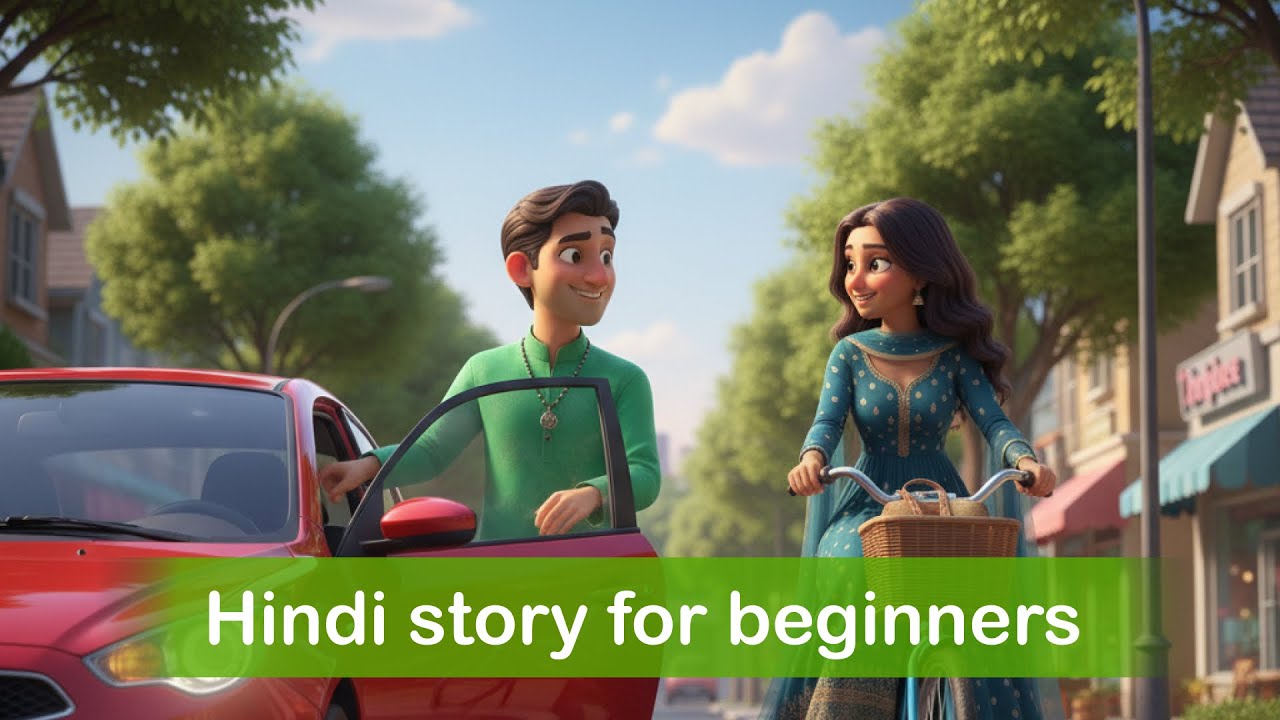
In this beginner Hindi lesson, you’ll learn how to describe everyday objects like vehicles. Join Aarav and Priya as they compare his new, big, red car with her old, small, blue cycle, and master essential adjectives and possessive pronouns along the way.
💬 Video Transcript
आरव: नमस्ते प्रिया! तुम कैसी हो?
(Aarav: Hello Priya! How are you?)
प्रिया: नमस्ते आरव! मैं ठीक हूँ। तुम कैसे हो?
(Priya: Hello Aarav! I am fine. How are you?)
आरव: मैं भी ठीक हूँ। प्रिया, बाहर आओ। देखो।
(Aarav: I am also fine. Priya, come outside. Look.)
प्रिया: क्या है, आरव? क्या देखूँ?
(Priya: What is it, Aarav? What should I see?)
आरव: यह देखो। यह मेरी गाड़ी है।
(Aarav: Look at this. This is my car.)
प्रिया: वाह! तुम्हारी गाड़ी बहुत सुंदर है। यह नई है?
(Priya: Wow! Your car is very beautiful. Is it new?)
आरव: हाँ, यह मेरी नई गाड़ी है।
(Aarav: Yes, this is my new car.)
प्रिया: यह बहुत अच्छी है। तुम्हारी गाड़ी का रंग क्या है?
(Priya: It is very nice. What is the color of your car?)
आरव: मेरी गाड़ी का रंग लाल है। यह एक लाल गाड़ी है।
(Aarav: The color of my car is red. It is a red car.)
प्रिया: लाल रंग बहुत अच्छा है। तुम्हारी गाड़ी बड़ी है।
(Priya: Red color is very nice. Your car is big.)
आरव: हाँ, मेरी गाड़ी बड़ी है। मुझे मेरी बड़ी, लाल गाड़ी पसंद है।
(Aarav: Yes, my car is big. I like my big, red car.)
प्रिया: बहुत अच्छा, आरव।
(Priya: Very good, Aarav.)
आरव: प्रिया, क्या तुम्हारे पास भी गाड़ी है?
(Aarav: Priya, do you also have a car?)
प्रिया: नहीं, आरव। मेरे पास गाड़ी नहीं है।
(Priya: No, Aarav. I don’t have a car.)
आरव: अच्छा? तो तुम्हारे पास क्या है?
(Aarav: Oh? So what do you have?)
प्रिया: मेरे पास एक साइकिल है।
(Priya: I have a cycle.)
आरव: तुम्हारी साइकिल कहाँ है?
(Aarav: Where is your cycle?)
प्रिया: मेरी साइकिल वहाँ है। वह देखो।
(Priya: My cycle is there. Look there.)
आरव: ओह! तुम्हारी साइकिल। तुम्हारी साइकिल का रंग क्या है?
(Aarav: Oh! Your cycle. What is the color of your cycle?)
प्रिया: मेरी साइकिल का रंग नीला है। वह एक नीली साइकिल है।
(Priya: The color of my cycle is blue. It is a blue cycle.)
आरव: तुम्हारी साइकिल भी बहुत सुंदर है।
(Aarav: Your cycle is also very beautiful.)
प्रिया: धन्यवाद, आरव। पर मेरी साइकिल पुरानी है।
(Priya: Thank you, Aarav. But my cycle is old.)
आरव: कोई बात नहीं। तुम्हारी नीली साइकिल अच्छी है।
(Aarav: No problem. Your blue cycle is good.)
प्रिया: तुम्हारी गाड़ी बड़ी है। मेरी साइकिल छोटी है।
(Priya: Your car is big. My cycle is small.)
आरव: हाँ, मेरी गाड़ी बड़ी है।
(Aarav: Yes, my car is big.)
प्रिया: और मेरी साइकिल छोटी है।
(Priya: And my cycle is small.)
आरव: तो, मेरे पास एक नई, बड़ी और लाल गाड़ी है।
(Aarav: So, I have a new, big, and red car.)
प्रिया: और मेरे पास एक पुरानी, छोटी और नीली साइकिल है।
(Priya: And I have an old, small, and blue cycle.)
आरव: चलो, प्रिया। हम बाज़ार चलते हैं।
(Aarav: Let’s go, Priya. We’ll go to the market.)
प्रिया: ठीक है, चलो। तुम अपनी गाड़ी में जाओ।
(Priya: Okay, let’s go. You go in your car.)
आरव: और तुम? तुम कैसे आओगी?
(Aarav: And you? How will you come?)
प्रिया: मैं अपनी साइकिल पर आती हूँ।
(Priya: I will come on my cycle.)
आरव: ठीक है। हम बाज़ार में मिलते हैं।
(Aarav: Okay. We will meet in the market.)
प्रिया: ठीक है, आरव। चलो।
(Priya: Okay, Aarav. Let’s go.)
📝 Essential Vocabulary
Here are some key words and phrases from the video. Listen and practice your pronunciation.
| Target Language | English Translation | Listen |
|---|---|---|
| गाड़ी | Car | |
| साइकिल | Cycle / Bicycle | |
| रंग | Color | |
| लाल | Red | |
| नीला / नीली | Blue | |
| बड़ा / बड़ी | Big | |
| छोटा / छोटी | Small | |
| नया / नई | New | |
| पुराना / पुरानी | Old | |
| मेरे पास | I have |
🎙 Say It Out Loud
Now it’s your turn to speak! Read these sentences aloud to practice describing vehicles and their colors. Your browser’s speech recognizer will listen and give you feedback, but nothing is recorded.
यह मेरी गाड़ी है। This is my car. मेरी साइकिल छोटी है। My cycle is small. मेरे पास एक साइकिल है। I have a cycle. मेरी गाड़ी का रंग लाल है। The color of my car is red.
🔍 Grammar Focus
This conversation highlights two fundamental concepts in Hindi grammar: possessive pronouns and adjective agreement.
1. Possessive Pronouns: मेरा (merā) vs. मेरी (merī)
In Hindi, the words for “my” and “your” change form to agree with the gender of the noun they describe, not the gender of the speaker.
मेरा(merā) is used for masculine nouns.मेरी(merī) is used for feminine nouns.
In the dialogue, both गा``ड़``ी (gāṛī - car) and सा``इकि``ल (sāikil - cycle) are feminine nouns. That’s why Aarav and Priya always use मे``र``ी (my) and तु``म्हार``ी (your, feminine form):
यहमे``र``ीगाड़ी है।(This is my car.)तु``म्हार``ीगाड़ी बहुत सुंदर है।(Your car is very beautiful.)
If they were talking about a masculine noun, like घर (ghar - house), they would use मे``र``ा and तु``म्हार``ा: मे``र``ा घर बड़ा है (My house is big).
2. Adjective Agreement
Just like possessive pronouns, adjectives in Hindi must also agree in gender with the nouns they modify. Many adjectives ending in -आ (-ā) for masculine nouns will change to -ई (-ī) for feminine nouns.
Notice how the adjectives change to describe the feminine nouns गा``ड़``ी and सा``इकि``ल:
- Aarav says his car is new and big:
मेरी नईगाड़ी(my new car),मेरी बड़ीगाड़ी(my big car). - Priya says her cycle is old and small:
मेरी पुरानीसाइकिल(my old cycle),मेरी छोटीसाइकिल(my small cycle).
The color adjective नीला (nīlā - blue) also changes to नीली (nīlī) for a feminine noun: वह एक नीली साइकिल है (That is a blue cycle). The adjective लाल (lāl - red) is an exception and doesn’t change form for gender.
साइकिल) are far more prevalent for daily commuting, especially in smaller towns and congested cities. They offer an affordable and nimble way to navigate traffic.🃏 Flip & Learn
Use these flashcards to test your memory of key phrases from the dialogue.
💡 Key Takeaways
Here are the three most important points to remember from this lesson:
- Possession with
मेरे पास: Useमेरे पास है(mere pās hai) to say “I have” andतुम्हारे पास है(tumhāre pās hai) to say “You have.” - Gender Agreement is Key: In Hindi, possessive pronouns (like
मेरी/मेरा) and adjectives (likeबड़ी/बड़ा) must match the gender of the noun they describe. - Basic Adjectives: You learned how to describe objects using essential adjectives for color (
लाल,नीली), size (बड़ी,छोटी), and condition (नई,पुरानी).
🎯 Practice Quiz
Check your understanding of the concepts covered in this lesson.
Quick check
Quick check
Quick check
✍️ Fill in the Blanks
Let’s test your spelling and memory! Fill in the missing words below. Use correct spelling.
Fill in the blank
Fill in the blank

Back PandaTwin
Your support pays for new lessons, original art, and audio across every course.


