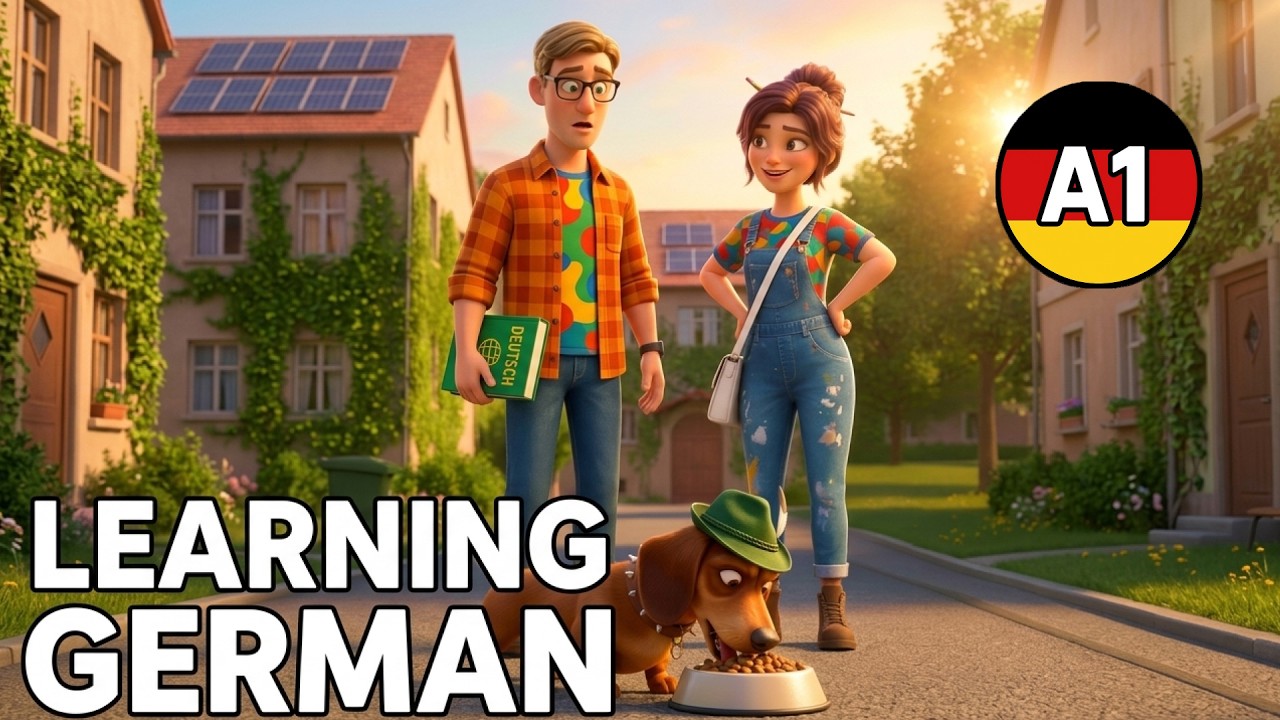
Talking About Pets and Food in German: A Beginner Dialogue 🐶
Learn how to talk about pets, express hunger, and discuss food choices in this beginner German story about a dog named Waldi.
- Video 43 of 63 in this unit
- Beginner · A1 — First words, greetings, and basic phrases
- Explore — extra practice and context, on Explore and Immersion


Ever since Clara became my study partner at the library, she has teased me about my color-coded daily schedules. Right now in our kitchen, I’m Oskar trying to analyze why my dachshund Waldi is small - ist klein - and definitely has hunger - hat Hunger - while completely rejecting his new organic kibble. In this lesson, you will master the irregular verbs sein (“to be”) and haben (“to have”) to describe characteristics and everyday needs.
In this beginner German lesson, you will learn essential vocabulary for talking about pets, eating habits, and everyday problems. Through a fun story about a dog named Waldi who refuses his new healthy diet, you will discover how to naturally express hunger, offer suggestions, and ultimately make simple plans-like ordering a pizza!
💬 Video Transcript
Oskar: Hallo Clara! Komm rein!
(Oskar: Hello Clara! Come in!)
Clara: Hallo Oskar! Wie geht es dir? Und wo ist Waldi?
(Clara: Hello Oskar! How are you? And where is Waldi?)
Oskar: Mir geht es gut, danke. Aber… wir haben ein Problem. Ein großes Problem.
(Oskar: I am doing well, thank you. But… we have a problem. A big problem.)
Clara: Oh nein! Ein Problem? Welches Problem?
(Clara: Oh no! A problem? What problem?)
Oskar: Schau hier. Es ist Waldi. Waldi ist nicht glücklich.
(Oskar: Look here. It’s Waldi. Waldi is not happy.)
Clara: Oh, der arme Waldi. Warum ist er nicht glücklich? Ist er krank?
(Clara: Oh, poor Waldi. Why is he not happy? Is he sick?)
Oskar: Nein, er ist nicht krank. Er hat Hunger. Großen Hunger.
(Oskar: No, he is not sick. He is hungry. Very hungry.)
Clara: Waldi hat Hunger? Das ist kein Problem. Gib Waldi sein Futter.
(Clara: Waldi is hungry? That is not a problem. Give Waldi his food.)
Oskar: Das ist das Problem. Ich gebe Waldi sein Futter. Aber Waldi frisst nicht.
(Oskar: That is the problem. I give Waldi his food. But Waldi is not eating.)
Clara: Er frisst nicht? Das ist komisch. Waldi hat immer Hunger.
(Clara: He is not eating? That is weird. Waldi is always hungry.)
Oskar: Ja. Normalerweise ja. Aber heute nicht. Schau hier. Das ist sein Futter.
(Oskar: Yes. Normally, yes. But not today. Look here. This is his food.)
Clara: Was ist das? Das sieht… neu aus. Das ist nicht sein normales Futter.
(Clara: What is that? That looks… new. That is not his normal food.)
Oskar: Richtig! Das ist neues Futter. Sehr gesundes Futter. Ich habe einen Plan für Waldi.
(Oskar: Right! That is new food. Very healthy food. I have a plan for Waldi.)
Clara: Du hast einen Plan? Für Waldis Futter?
(Clara: You have a plan? For Waldi’s food?)
Oskar: Ja, einen Futter-Plan! Der Plan ist sehr gut. Montag bekommt Waldi Futter A. Dienstag bekommt Waldi Futter B.
(Oskar: Yes, a feeding plan! The plan is very good. Monday Waldi gets Food A. Tuesday Waldi gets Food B.)
Clara: Und heute ist Mittwoch. Was bekommt Waldi am Mittwoch?
(Clara: And today is Wednesday. What does Waldi get on Wednesday?)
Oskar: Heute bekommt Waldi Futter C. Das ist Hähnchen mit Karotten. Sehr gesund!
(Oskar: Today Waldi gets Food C. That is chicken with carrots. Very healthy!)
Clara: Hähnchen mit Karotten. Ah. Und Waldi mag das nicht?
(Clara: Chicken with carrots. Ah. And Waldi doesn’t like that?)
Oskar: Nein. Er schaut nur. Er riecht. Aber er frisst nicht. Mein Plan funktioniert nicht.
(Oskar: No. He just looks. He smells. But he doesn’t eat. My plan isn’t working.)
Clara: Oskar, dein Plan ist sehr… genau. Vielleicht zu genau. Waldi ist ein Hund. Er braucht keinen komplizierten Plan.
(Clara: Oskar, your plan is very… exact. Maybe too exact. Waldi is a dog. He doesn’t need a complicated plan.)
Oskar: Aber ich will nur das Beste für Waldi!
(Oskar: But I only want the best for Waldi!)
Clara: Das weiß ich. Aber schau ihn an. Er ist traurig. Er will sein altes Futter.
(Clara: I know that. But look at him. He is sad. He wants his old food.)
Oskar: Mein altes Futter? Das einfache Futter?
(Oskar: My old food? The simple food?)
Clara: Ja, das einfache Futter. Wo ist es?
(Clara: Yes, the simple food. Where is it?)
Oskar: Es ist im Schrank. Hier.
(Oskar: It is in the cupboard. Here.)
Clara: Super. Ich habe eine Idee. Eine einfache Idee. Ohne Plan.
(Clara: Great. I have an idea. A simple idea. Without a plan.)
Oskar: Eine Idee ohne Plan? Was für eine Idee?
(Oskar: An idea without a plan? What kind of idea?)
Clara: Wir geben Waldi sein altes Futter. Nur ein bisschen. Zum Probieren.
(Clara: We give Waldi his old food. Just a little bit. To taste.)
Oskar: Meinst du? Ist das eine gute Idee?
(Oskar: Do you think so? Is that a good idea?)
Clara: Wir versuchen es. Schau, Waldi! Was habe ich hier?
(Clara: We will try it. Look, Waldi! What do I have here?)
Oskar: Er schaut. Seine Nase bewegt sich.
(Oskar: He is looking. His nose is moving.)
Clara: Ich mache das Futter in seinen Napf. So. Jetzt, Waldi. Bitte schön.
(Clara: I am putting the food in his bowl. There. Now, Waldi. Here you go.)
Oskar: Oh! Schau! Er frisst! Clara, er frisst!
(Oskar: Oh! Look! He is eating! Clara, he is eating!)
Clara: Ja, natürlich frisst er. Es ist sein Lieblingsfutter.
(Clara: Yes, of course he is eating. It is his favorite food.)
Oskar: Er frisst alles. Der Napf ist schon fast leer. Er ist wieder glücklich!
(Oskar: He is eating everything. The bowl is already almost empty. He is happy again!)
Clara: Siehst du? Manchmal ist einfach besser. Ein komplizierter Plan ist nicht immer gut.
(Clara: You see? Sometimes simple is better. A complicated plan is not always good.)
Oskar: Du hast recht. Ein glücklicher Hund ist wichtiger als ein perfekter Plan.
(Oskar: You are right. A happy dog is more important than a perfect plan.)
Clara: Genau! Waldi ist glücklich. Und jetzt… ich habe auch Hunger.
(Clara: Exactly! Waldi is happy. And now… I am hungry too.)
Oskar: Ich auch! Ich habe eine Idee. Ein einfacher Plan.
(Oskar: Me too! I have an idea. A simple plan.)
Clara: Ein einfacher Plan? Das gefällt mir! Was ist dein Plan?
(Clara: A simple plan? I like that! What is your plan?)
Oskar: Wir bestellen Pizza!
(Oskar: We are ordering pizza!)
Clara: Pizza! Das ist ein perfekter Plan!
(Clara: Pizza! That is a perfect plan!)

📝 Essential Vocabulary
| Target Language | English Translation | Listen |
|---|---|---|
| das Problem | the problem | |
| der Hunger | the hunger | |
| das Futter | the pet food | |
| fressen | to eat (for animals) | |
| gesund | healthy | |
| der Napf | the feeding bowl | |
| probieren | to taste / to try | |
| bestellen | to order |
🔍 Grammar Focus
Expressing Hunger: Haben vs. Sein
In English, you describe yourself as being hungry (“I am hungry”). In German, hunger is treated as a noun-it is something you have. You must use the verb haben (to have) instead of sein (to be). Notice how Oskar and Clara talk about Waldi’s hunger:
- Er hat Hunger. (He is hungry / He has hunger)
- Waldi hat immer Hunger. (Waldi is always hungry / Waldi always has hunger)
Essen vs. Fressen
German has two different verbs for “to eat” depending on who is doing the eating! When humans eat, you use the verb essen. When animals eat, you must use the verb fressen. Using “fressen” for a person is considered very rude (like saying they are eating like an animal), but it is the perfectly normal and correct word for pets.
- Aber Waldi frisst nicht. (But Waldi is not eating.)
- Ja, natürlich frisst er. Es ist sein Lieblingsfutter. (Yes, of course he is eating. It is his favorite food.)


🃏 Flip & Learn
💡 Key Takeaways
- Haben Hunger: Always use the verb haben (to have) with Hunger to express that you are hungry. Avoid directly translating “I am hungry” with the verb sein.
- Fressen for animals: Remember that animals fressen while humans essen.
- Keep it simple: Just like Clara’s simple plan to give Waldi his old food and order pizza, simple solutions are often the best! Manchmal ist einfach besser. (Sometimes simple is better.)
🎯 Practice Quiz
Quick check
Quick check
Quick check
✍️ Fill in the Blanks
Let’s test your spelling and memory! Fill in the missing words below. Use correct spelling.
Fill in the blank
Fill in the blank


Back PandaTwin
Clara here! We're building this course a lesson at a time, and your support is what keeps it moving.