Starting Your First Conversation in French: Greetings & Survival Vocabulary 👋
Ready for your first French conversation? This lesson covers over 20 essential survival phrases, from greetings like 'Bonjour' and 'Ça va?' to asking for help and introducing yourself.
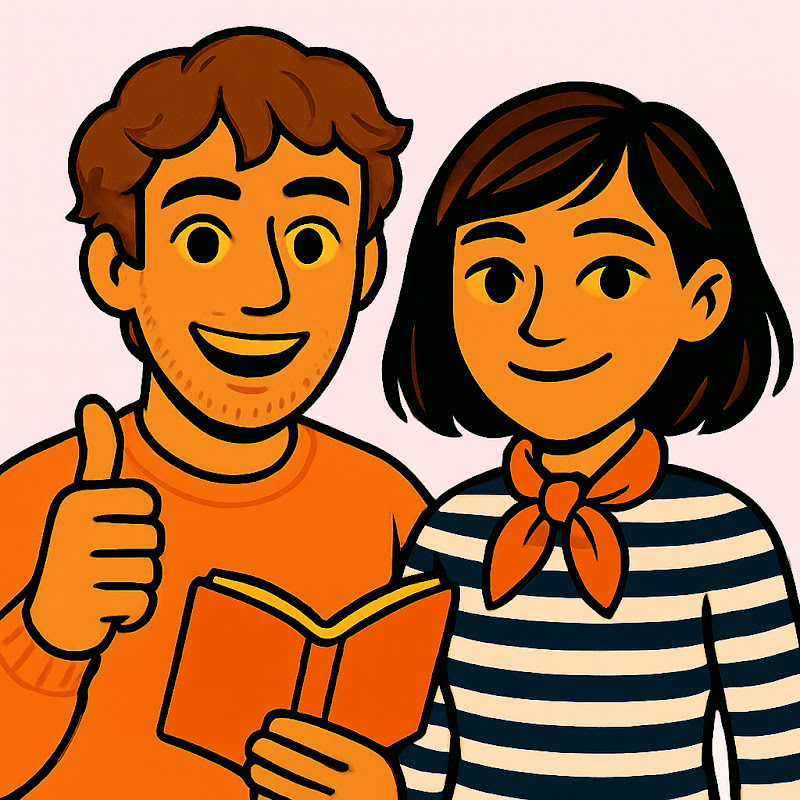
Starting a new language can be daunting, but with a few key phrases, you can navigate your first conversations with ease. In this lesson, join Léo and Chloé as they walk you through the most important French survival phrases, from basic greetings and introductions to asking for help and saying goodbye.
💬 Video Transcript
Léo: Bonjour. Bonjour.
(Léo: Hello. Hello.)
Chloé: Salut. Salut.
(Chloé: Hi. Hi.)
Léo: Ça va ? Ça va ?
(Léo: How are you? How are you?)
Chloé: Ça va bien, merci. Ça va bien, merci.
(Chloé: I’m well, thank you. I’m well, thank you.)
Léo: Et toi ? Et toi ?
(Léo: And you? And you?)
Chloé: Oui. Oui.
(Chloé: Yes. Yes.)
Léo: Non. Non.
(Léo: No. No.)
Chloé: S’il te plaît. S’il te plaît.
(Chloé: Please. Please. [informal])
Léo: S’il vous plaît. S’il vous plaît.
(Léo: Please. Please. [formal])
Chloé: Merci. Merci.
(Chloé: Thank you. Thank you.)
Léo: Merci beaucoup. Merci beaucoup.
(Léo: Thank you very much. Thank you very much.)
Chloé: De rien. De rien.
(Chloé: You’re welcome. You’re welcome.)
Léo: Pardon. Pardon.
(Léo: Sorry / Pardon me. Sorry / Pardon me.)
Chloé: Excusez-moi. Excusez-moi.
(Chloé: Excuse me. Excuse me.)
Léo: Je m’appelle Léo. Je m’appelle Léo.
(Léo: My name is Léo. My name is Léo.)
Chloé: Comment tu t’appelles ? Comment tu t’appelles ?
(Chloé: What is your name? What is your name? [informal])
Léo: Je suis français. Je suis français.
(Léo: I am French. I am French. [masculine])
Chloé: Je suis française. Je suis française.
(Chloé: I am French. I am French. [feminine])
Léo: Tu parles anglais ? Tu parles anglais ?
(Léo: Do you speak English? Do you speak English? [informal])
Chloé: Je ne comprends pas. Je ne comprends pas.
(Chloé: I don’t understand. I don’t understand.)
Léo: Je ne sais pas. Je ne sais pas.
(Léo: I don’t know. I don’t know.)
Chloé: Parlez plus lentement. Parlez plus lentement.
(Chloé: Speak more slowly. Speak more slowly.)
Léo: Où sont les toilettes ? Où sont les toilettes ?
(Léo: Where are the restrooms? Where are the restrooms?)
Chloé: Au revoir. Au revoir.
(Chloé: Goodbye. Goodbye.)
Léo: Bonne journée. Bonne journée.
(Léo: Have a good day. Have a good day.)
📝 Essential Vocabulary
Here are some of the most important words and phrases from the video. Listen to the pronunciation and get ready to use them yourself!
| Target Language | English Translation | Pronunciation |
|---|---|---|
| Bonjour | Hello | |
| Ça va ? | How are you? | |
| S’il vous plaît | Please (formal) | |
| Merci beaucoup | Thank you very much | |
| De rien | You’re welcome | |
| Comment tu t’appelles ? | What is your name? (informal) | |
| Je ne comprends pas | I don’t understand | |
| Où sont les toilettes ? | Where are the restrooms? |
🔍 Grammar Focus
Let’s look at two important grammar points that came up in the dialogue.
Formal vs. Informal ‘You’ (vous vs. tu)
French has two ways to say “you.” Choosing the right one is crucial for showing respect.
tuis the informal “you,” used with friends, family, children, and people you know well.vousis the formal “you,” used with strangers, older people, in professional settings, or when addressing a group of people.
In the script, we see both:
S'il **te** plaît(Please - informal)S'il **vous** plaît(Please - formal)
Notice also Comment **tu** t'appelles ? (What is your name?) and **Tu** parles anglais ? (Do you speak English?), which both use the informal tu.
Masculine vs. Feminine Adjectives
In French, many adjectives change their form to agree with the gender of the noun they describe. This is very common when talking about nationality.
Léo, a male, says:
- Je suis français.
Chloé, a female, adds an “e” to the end:
- Je suis française.
This is a common pattern for many nationalities and descriptive words. Always pay attention to who is speaking!
🌍 Cultural Tip
🃏 Flip & Learn
Use these flashcards to test your memory on some key phrases from the lesson.
How are you?
Ça va ?
Please (formal)
S'il vous plaît
I don't understand.
Je ne comprends pas.
What is your name? (informal)
Comment tu t'appelles ?
Where are the restrooms?
Où sont les toilettes ?
💡 Key Takeaways
Here are the most important points to remember from this lesson:
- Use
Bonjourfor “Hello” in most situations, andSalutfor a more informal “Hi” with friends. - Always remember the difference between formal (
vous) and informal (tu). When in doubt, usingvousis safer and more polite. - French adjectives often change to agree with gender. A male speaker says
Je suis français, while a female speaker saysJe suis française. - Mastering polite phrases like
Merci(Thank you),De rien(You’re welcome), andPardon(Sorry) will make your interactions much smoother.
🎯 Practice Quiz
Let’s see what you’ve learned. Choose the best answer for each question.
Question
Question
Question
✍️ Fill in the Blanks
Let’s test your spelling and memory! Fill in the missing words below. Use correct spelling.
Fill in the blank
Fill in the blank
Support Us
Did you find this lesson helpful? Your support is what makes it possible for us to keep creating free, high-quality educational content.