Describing Problems in French: Jam Jar Dialogue & Food Vocabulary 🍓
Learn basic French with a funny story about an unopenable jam jar. This A1 dialogue helps you practice expressing hunger, describing problems, and asking for help.
In this slow French lesson for A1 beginners, you’ll follow a simple and funny story about Léo, who is very hungry but can’t open his favorite jar of strawberry jam. You will learn essential vocabulary for expressing hunger, describing a problem, and asking a friend for help.
💬 Video Transcript
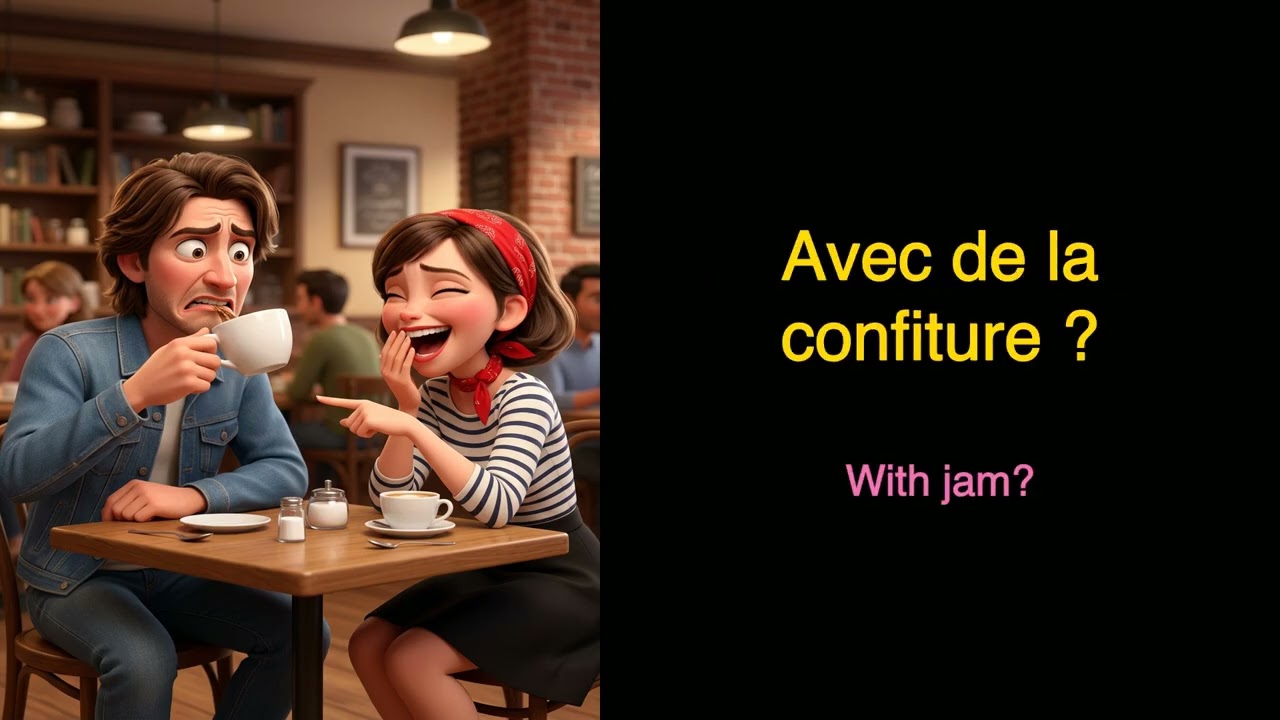
Léo: Oh… j’ai faim. J’ai très faim. Je veux un goûter. Oui, un bon goûter. Qu’est-ce que je veux manger ? Ah ! Je sais ! Du pain avec de la confiture. J’aime beaucoup la confiture de fraise. Voici le pain. Et voici… le pot de confiture ! C’est ma confiture préférée. Miam ! Bon. J’ouvre le pot. J’essaie d’ouvrir. Je tourne… et je tourne encore… Oh là là. C’est difficile. Très difficile. J’essaie encore une fois. Je suis un homme fort. Allez ! Je tourne… très, très fort ! Hmmm… Je n’arrive pas. Je ne peux pas ouvrir ce pot. Pourquoi c’est si difficile ? Qu’est-ce que je fais ? J’ai très faim ! Je veux ma tartine ! J’ai une idée ! J’appelle mon amie Chloé. Chloé est très forte et très intelligente.
(Léo: Oh… I’m hungry. I’m very hungry. I want a snack. Yes, a good snack. What do I want to eat? Ah! I know! Bread with jam. I really like strawberry jam. Here is the bread. And here is… the jam jar! It’s my favorite jam. Yum! Okay. I’ll open the jar. I try to open. I turn… and I turn again… Oh dear. It’s difficult. Very difficult. I’ll try one more time. I am a strong man. Come on! I turn… very, very hard! Hmmm… I can’t do it. I can’t open this jar. Why is it so difficult? What do I do? I’m very hungry! I want my slice of bread with jam! I have an idea! I’ll call my friend Chloé. Chloé is very strong and very smart.)
Chloé: Allô ?
(Chloé: Hello?)
Léo: Salut Chloé, c’est Léo.
(Léo: Hi Chloé, it’s Léo.)
Chloé: Salut Léo ! Ça va ?
(Chloé: Hi Léo! How are you?)
Léo: Non, ça ne va pas bien. J’ai un gros problème.
(Léo: No, I’m not doing well. I have a big problem.)
Chloé: Un gros problème ? Oh non ! Qu’est-ce qui se passe ?
(Chloé: A big problem? Oh no! What’s happening?)
Léo: Je suis dans ma cuisine. J’ai faim. Je veux une tartine à la confiture.
(Léo: I’m in my kitchen. I’m hungry. I want a slice of bread with jam.)
Chloé: D’accord… Et alors ?
(Chloé: Okay… And so?)
Léo: Le problème, c’est le pot ! Le pot de confiture ! Je n’arrive pas à ouvrir le pot. C’est impossible !
(Léo: The problem is the jar! The jam jar! I can’t manage to open the jar. It’s impossible!)
Chloé: Le pot de confiture est le gros problème ?
(Chloé: The jam jar is the big problem?)
Léo: Oui ! C’est un problème très important. J’ai faim !
(Léo: Yes! It’s a very important problem. I’m hungry!)
Chloé: D’accord, Léo, d’accord. Je comprends. J’arrive pour t’aider.
(Chloé: Okay, Léo, okay. I understand. I’m coming to help you.)
Léo: Vraiment ? Oh, merci Chloé ! Tu es la meilleure ! À tout de suite.
(Léo: Really? Oh, thank you Chloé! You’re the best! See you in a moment.)
Chloé: Oui. À tout de suite.
(Chloé: Yes. See you in a moment.)
Léo: Super. Mon amie Chloé arrive.
(Léo: Great. My friend Chloé is coming.)
Chloé: Salut Léo ! Alors, où est ce pot ?
(Chloé: Hi Léo! So, where is this jar?)
Léo: Il est ici. Sur la table. Le voilà.
(Léo: It’s here. On the table. There it is.)
Chloé: Ah oui, le pot de confiture de fraise. Mmm, j’aime ça.
(Chloé: Ah yes, the jar of strawberry jam. Mmm, I like that.)
Léo: Moi aussi ! Mais il est fermé. Très, très fermé. J’ai essayé fort, mais… impossible.
(Léo: Me too! But it’s closed. Very, very closed. I tried hard, but… impossible.)
Chloé: Je peux essayer ?
(Chloé: Can I try?)
Léo: Oui, s’il te plaît. Mais attention, c’est très difficile.
(Léo: Yes, please. But be careful, it’s very difficult.)
Chloé: D’accord. Je regarde… Et voilà ! C’est ouvert.
(Chloé: Okay. I’m looking… And there you go! It’s open.)
Léo: Quoi ?! C’est ouvert ? Mais… comment tu as fait ? C’est de la magie !
(Léo: What?! It’s open? But… how did you do it? It’s magic!)
Chloé: Non, ce n’est pas de la magie, Léo. C’est facile.
(Chloé: No, it’s not magic, Léo. It’s easy.)
Léo: Facile ? Pour moi, c’est impossible. Pour toi, c’est facile. Tu es très forte !
(Léo: Easy? For me, it’s impossible. For you, it’s easy. You are very strong!)
Chloé: Oui, je suis forte !
(Chloé: Yes, I am strong!)
Léo: Merci, merci, merci Chloé ! Maintenant, on mange le goûter !
(Léo: Thank you, thank you, thank you Chloé! Now, we eat the snack!)
Chloé: Oui ! Avec plaisir. J’ai faim maintenant.
(Chloé: Yes! With pleasure. I’m hungry now.)
Léo: Parfait ! Une tartine pour toi, et une tartine pour moi. Je prends le pain. Je mets la confiture sur le pain. Voilà ta tartine, Chloé.
(Léo: Perfect! A slice for you, and a slice for me. I take the bread. I put the jam on the bread. Here is your slice, Chloé.)
Chloé: Merci, Léo.
(Chloé: Thank you, Léo.)
Léo: Et voilà ma tartine. Mmm, c’est délicieux.
(Léo: And here is my slice. Mmm, it’s delicious.)
Chloé: Oui, c’est très, très bon.
(Chloé: Yes, it’s very, very good.)
Léo: C’est la meilleure confiture.
(Léo: It’s the best jam.)
Chloé: Surtout quand le pot est ouvert !
(Chloé: Especially when the jar is open!)
Léo: Oui, surtout quand le pot est ouvert. Merci encore, Chloé.
(Léo: Yes, especially when the jar is open. Thanks again, Chloé.)
📝 Essential Vocabulary
Here are some key words and phrases from the video. Listen to the pronunciation and practice saying them out loud.
| Target Language | English Translation | Pronunciation |
|---|---|---|
| J’ai faim | I am hungry | |
| Un goûter | A snack | |
| La confiture | The jam | |
| Le pot | The jar | |
| J’essaie | I try | |
| C’est difficile | It’s difficult | |
| Je n’arrive pas | I can’t manage / I can’t do it | |
| Un problème | A problem | |
| Une tartine | A slice of bread with spread |
🔍 Grammar Focus
Let’s look at two important grammar points from the dialogue.
1. Expressing Hunger with Avoir
In English, we say “I am hungry,” using the verb “to be.” In French, you must use the verb avoir, which means “to have.” This is a common pattern for many physical states and feelings.
Notice how Léo says it:
- J’ai faim. (I have hunger. / I am hungry.)
- J’ai très faim. (I have very much hunger. / I am very hungry.)
Remember this structure: subject + avoir + faim. You will use avoir for other feelings too, like J’ai soif (I am thirsty) and J’ai froid (I am cold).
2. Basic Negation with Ne… pas
To make a sentence negative in French, you typically wrap the verb with two words: ne and pas. The basic structure is: subject + ne + verb + pas.
We see several examples in the script:
- Je n’arrive pas. (I can’t manage.)
- Je ne peux pas ouvrir ce pot. (I cannot open this jar.)
- Non, ce n’est pas de la magie. (No, it is not magic.)
- Non, ça ne va pas bien. (No, it is not going well.)
Note that when the verb starts with a vowel, ne becomes n’. For example, arrive starts with ‘a’, so we say n’arrive pas.
🌍 Cultural Tip
🃏 Flip & Learn
Use these flashcards to test your memory of key phrases from the story.
I am hungry
J'ai faim
The jam jar
Le pot de confiture
It's difficult
C'est difficile
I can't do it
Je n'arrive pas
What's happening?
Qu'est-ce qui se passe ?
💡 Key Takeaways
Here are the most important points to remember from this lesson:
- To say you are hungry in French, use the verb avoir (to have): J’ai faim.
- The basic structure for making a sentence negative is ne … pas around the verb, like in Je n’arrive pas.
- Une tartine is a very common word in French for a slice of bread with a topping like jam, butter, or chocolate spread.
- You can describe a problem simply by saying J’ai un problème.
- The phrase Qu’est-ce qui se passe ? is a useful way to ask “What’s wrong?” or “What’s happening?”.
🎯 Practice Quiz
Test your understanding of the vocabulary and grammar from the dialogue.
Question
Question
Question
✍️ Fill in the Blanks
Let’s test your spelling and memory! Fill in the missing words below. Use correct spelling.
Fill in the blank
Fill in the blank
Support Us
Did you find this lesson helpful? Your support is what makes it possible for us to keep creating free, high-quality educational content.