Talking About Farm Animals in French: Beginner Vocabulary & Conversation 🐄
Learn how to name farm animals, describe their sizes and colors, and mimic their sounds in this beginner-friendly French conversation.
In this lesson, you will join Léo and Chloé as they explore a large farm and discover different animals. You will learn essential vocabulary for naming animals like cows, sheep, and chickens, as well as how to describe their colors and sizes in French. Get ready to practice your listening skills and even learn the unique sounds these animals make in France!
Index
💬 Video Transcript
Léo: Salut Chloé ! Regarde ! Nous sommes à la ferme !
(Léo: Hi Chloé! Look! We are at the farm!)
Chloé: Salut Léo ! Oui, c’est une très grande ferme. C’est joli ici.
(Chloé: Hi Léo! Yes, it’s a very big farm. It’s pretty here.)
Léo: J’aime beaucoup la ferme. Il y a des animaux ?
(Léo: I really like the farm. Are there animals?)
Chloé: Oui, bien sûr. Regarde là-bas, Léo.
(Chloé: Yes, of course. Look over there, Léo.)
Léo: Oh ! Qu’est-ce que c’est ? C’est un très grand animal.
(Léo: Oh! What is that? It’s a very big animal.)
Chloé: C’est une vache.
(Chloé: It’s a cow.)
Léo: Une vache ? Ah oui, une vache. Elle est grande !
(Léo: A cow? Ah yes, a cow. She is big!)
Chloé: Oui, c’est une grande vache. Elle est noire et blanche.
(Chloé: Yes, it’s a big cow. She is black and white.)
Léo: Une grande vache, noire et blanche. J’aime sa couleur.
(Léo: A big cow, black and white. I like her color.)
Chloé: Moi aussi. Écoute, Léo. La vache parle.
(Chloé: Me too. Listen, Léo. The cow is speaking.)
Léo: Elle fait “meuhhh” ! C’est amusant ! Meuhhh !
(Léo: She goes “moo”! It’s fun! Moo!)
Chloé: Oui, c’est ça. La vache fait “meuhhh”.
(Chloé: Yes, that’s it. The cow goes “moo”.)
Léo: Super ! Un autre animal ! Regarde, Chloé ! C’est quoi ?
(Léo: Great! Another animal! Look, Chloé! What is it?)
Chloé: Cet animal est un mouton.
(Chloé: This animal is a sheep.)
Léo: Un mouton ? Il est plus petit que la vache.
(Léo: A sheep? It is smaller than the cow.)
Chloé: Oui, le mouton est petit. Et il est tout blanc.
(Chloé: Yes, the sheep is small. And it is all white.)
Léo: Un petit mouton blanc. Il est mignon.
(Léo: A small white sheep. It is cute.)
Chloé: Oui, très mignon. Écoute le bruit du mouton.
(Chloé: Yes, very cute. Listen to the sound of the sheep.)
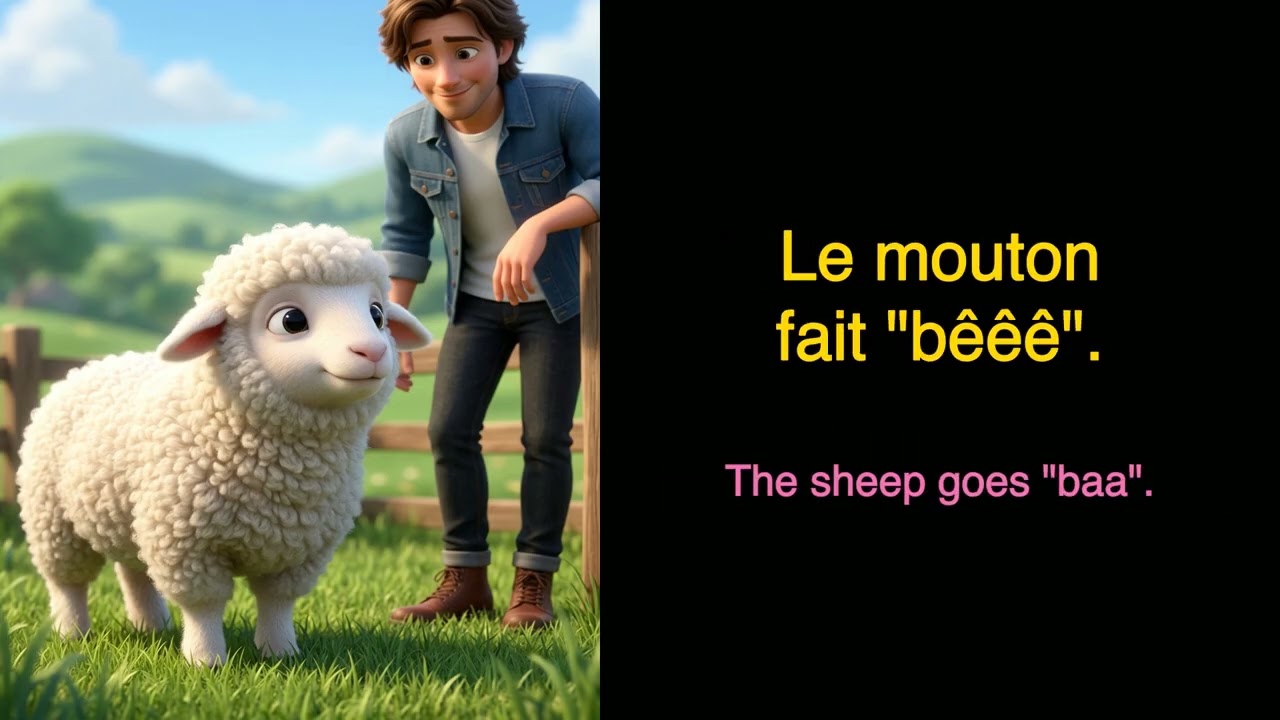
Léo: Le mouton fait “bêêê”.
(Léo: The sheep goes “baa”.)
Chloé: Parfait ! Le mouton fait “bêêê”.
(Chloé: Perfect! The sheep goes “baa”.)
Léo: “Bêêê” ! C’est doux. J’aime le mouton.
(Léo: “Baa”! It’s soft. I like the sheep.)
Chloé: Alors, nous avons une grande vache et un petit mouton.
(Chloé: So, we have a big cow and a small sheep.)
Léo: Oui ! Et là ? Chloé, regarde ! C’est un animal très, très petit !
(Léo: Yes! And there? Chloé, look! It’s a very, very small animal!)
Chloé: Ah, ça ? C’est une poule.
(Chloé: Ah, that? It’s a hen.)
Léo: Une poule. Elle est rousse. Une jolie poule rousse.
(Léo: A hen. She is red. A pretty red hen.)
Chloé: Oui. Et elle cherche des graines pour manger.
(Chloé: Yes. And she is looking for seeds to eat.)
Léo: La poule fait un bruit aussi ?
(Léo: Does the hen make a sound too?)
Chloé: Oui. La poule fait “cot cot cot”.
(Chloé: Yes. The hen goes “cluck cluck cluck”.)
Léo: “Cot cot cot” ! C’est un bruit très rapide !
(Léo: “Cluck cluck cluck”! It’s a very fast sound!)
Chloé: Oui, c’est le son de la poule.
(Chloé: Yes, that is the sound of the hen.)
Léo: J’adore la ferme ! Il y a la vache qui fait “meuhhh”.
(Léo: I love the farm! There is the cow that goes “moo”.)
Chloé: Oui. Et le mouton qui fait “bêêê”.
(Chloé: Yes. And the sheep that goes “baa”.)
Léo: Oui ! Et la poule qui fait “cot cot cot”. C’est une belle journée.
(Léo: Yes! And the hen that goes “cluck cluck cluck”. It’s a beautiful day.)
Chloé: Je suis d’accord, Léo. C’est une très belle journée à la ferme.
(Chloé: I agree, Léo. It’s a very beautiful day at the farm.)
Léo: On continue la visite ? Je veux voir d’autres animaux !
(Léo: Shall we continue the tour? I want to see other animals!)
Chloé: D’accord. Allons voir les canards près de l’eau.
(Chloé: Okay. Let’s go see the ducks near the water.)
Léo: Les canards ! Super ! Allons-y !
(Léo: The ducks! Great! Let’s go!)
📝 Essential Vocabulary
| Target Language | English Translation | Pronunciation |
|---|---|---|
| la ferme | the farm | |
| une vache | a cow | |
| un mouton | a sheep | |
| une poule | a hen / chicken | |
| un canard | a duck | |
| grand | big | |
| petit | small | |
| des graines | seeds |
🔍 Grammar Focus
Adjective Agreement and Placement
In French, adjectives must match the noun they describe in both gender (masculine or feminine) and number (singular or plural). Furthermore, while most adjectives go after the noun in French, short common adjectives describing size (like big or small) typically go before the noun. Colors, however, always go after.
Notice how Chloé and Léo describe the feminine noun vache (cow):
- Une grande vache (A big cow — size adjective before, with feminine ’e’ ending)
- Elle est noire et blanche (She is black and white — color adjectives after, with feminine ’e’ endings)
Compare this to how they describe the masculine noun mouton (sheep):
- Un petit mouton blanc (A small white sheep — masculine size adjective before, masculine color adjective after)
Asking “What is it?”
When Léo sees an animal he doesn’t recognize, he asks:
- Qu’est-ce que c’est ? (What is it?)
Chloé answers using the structure C’est + [noun]:
- C’est une vache. (It’s a cow.)
- C’est une poule. (It’s a hen.)
This is the most common and natural way to identify objects or animals in French!
🌍 Cultural Tip
🃏 Flip & Learn
a cow
une vache
a sheep
un mouton
a hen
une poule
the farm
la ferme
small
petit
💡 Key Takeaways
- Farm Vocabulary: You can now name basic farm animals like une vache (a cow), un mouton (a sheep), une poule (a hen), and un canard (a duck).
- Identifying Things: Use Qu’est-ce que c’est ? to ask “What is it?” and reply with C’est… (It is…).
- Describing Nouns: Remember that size adjectives like grand(e) and petit(e) go before the noun, but colors like blanc or rousse go after the noun.
- Animal Sounds: French animals have their own sounds: meuhhh for cows, bêêê for sheep, and cot cot cot for hens.
🎯 Practice Quiz
Question
Question
Question
✍️ Fill in the Blanks
Let’s test your spelling and memory! Fill in the missing words below. Use correct spelling.
Fill in the blank
Fill in the blank
Support Us
Did you find this lesson helpful? Your support is what makes it possible for us to keep creating free, high-quality educational content.