Talking About Breakfast in French: Beginner Daily Routine Vocabulary 🍳
Learn essential French breakfast vocabulary and how to handle kitchen disasters in this beginner-friendly dialogue. Perfect for mastering daily routine conversations in French.
Prepare to expand your daily vocabulary as Léo attempts to make a special breakfast for Chloé—with disastrous, yet hilarious, results. In this lesson, you will learn essential food and kitchen vocabulary like le sucre (sugar), le sel (salt), and le pain grillé (toast). You will also discover how to express likes, dislikes, and apologize in French when things don’t go according to plan!
Index
💬 Video Transcript (Transcription de la vidéo)
Léo: Salut Chloé ! Entre, entre !
(Léo: Hi Chloé! Come in, come in!)
Chloé: Salut Léo ! Ça va ?
(Chloé: Hi Léo! How are you?)
Léo: Ça va très bien. J’ai une surprise pour toi aujourd’hui.
(Léo: I’m doing very well. I have a surprise for you today.)
Chloé: Une surprise ? Oh, j’adore les surprises ! Qu’est-ce que c’est ?
(Chloé: A surprise? Oh, I love surprises! What is it?)
Léo: Viens avec moi dans la cuisine.
(Léo: Come with me into the kitchen.)
Chloé: D’accord. Nous allons dans la cuisine. Alors, cette surprise ?
(Chloé: Okay. We are going into the kitchen. So, this surprise?)
Léo: Tada ! Je prépare le petit-déjeuner. C’est un petit-déjeuner spécial.
(Léo: Tada! I am preparing breakfast. It’s a special breakfast.)
Chloé: Oh, Léo ! C’est vraiment gentil ! Tu prépares le petit-déjeuner pour moi ?
(Chloé: Oh, Léo! That is really nice! You are preparing breakfast for me?)
Léo: Oui, pour toi ! Pour commencer, un bon café.
(Léo: Yes, for you! To start, a good coffee.)
Chloé: Mmm, j’adore l’odeur du café le matin. Merci.
(Chloé: Mmm, I love the smell of coffee in the morning. Thank you.)
Léo: Tu veux du sucre dans ton café ?
(Léo: Do you want sugar in your coffee?)
Chloé: Oui, un peu de sucre, s’il te plaît.
(Chloé: Yes, a little bit of sugar, please.)
Léo: Voilà. Je mets le sucre. C’est prêt. Un café spécial pour une amie spéciale.
(Léo: Here you go. I’m putting the sugar in. It’s ready. A special coffee for a special friend.)
Chloé: Merci beaucoup, Léo. Je goûte tout de suite. … Berk !
(Chloé: Thank you very much, Léo. I’ll taste it right away. … Yuck!)
Léo: Chloé ? Qu’est-ce qu’il y a ? Tu n’aimes pas le café ?
(Léo: Chloé? What’s wrong? Do you not like the coffee?)
Chloé: Léo… ce café est… étrange. Il est très salé.
(Chloé: Léo… this coffee is… strange. It is very salty.)
Léo: Salé ? Impossible ! J’ai mis du sucre. Je suis sûr.
(Léo: Salty? Impossible! I put sugar. I am sure.)
Chloé: Goûte un peu. Vraiment, il est salé.
(Chloé: Taste a little. Really, it is salty.)
Léo: D’accord, je goûte… Oh non ! C’est horrible ! C’est du sel !
(Léo: Okay, I’ll taste it… Oh no! It’s horrible! It’s salt!)
Chloé: Oui, c’est du sel.
(Chloé: Yes, it’s salt.)
Léo: Oh, je suis vraiment désolé Chloé ! Pardon !
(Léo: Oh, I am really sorry Chloé! Sorry!)
Chloé: (Elle rit) Ce n’est pas grave, Léo. C’est drôle !
(Chloé: (She laughs) It’s no big deal, Léo. It’s funny!)
Léo: Je suis confus. Regarde. Le pot de sel est blanc. Le pot de sucre est blanc. Ils sont pareils.
(Léo: I am confused. Look. The salt pot is white. The sugar pot is white. They are the same.)
Chloé: C’est une petite erreur. Ça arrive. Bon, pas de café pour moi ce matin.
(Chloé: It’s a small mistake. It happens. Well, no coffee for me this morning.)
Léo: Attends ! Ce n’est pas fini ! Le plat principal arrive !
(Léo: Wait! It’s not over! The main course is coming!)
Chloé: Le plat principal ? Pour le petit-déjeuner ?
(Chloé: The main course? For breakfast?)
Léo: Oui ! Du pain grillé !
(Léo: Yes! Toast!)
Chloé: Ah, j’aime le pain grillé ! C’est une super idée.
(Chloé: Ah, I like toast! It’s a great idea.)
Léo: Je prends deux tranches de pain. Je les mets dans le grille-pain.
(Léo: I’ll take two slices of bread. I’m putting them in the toaster.)
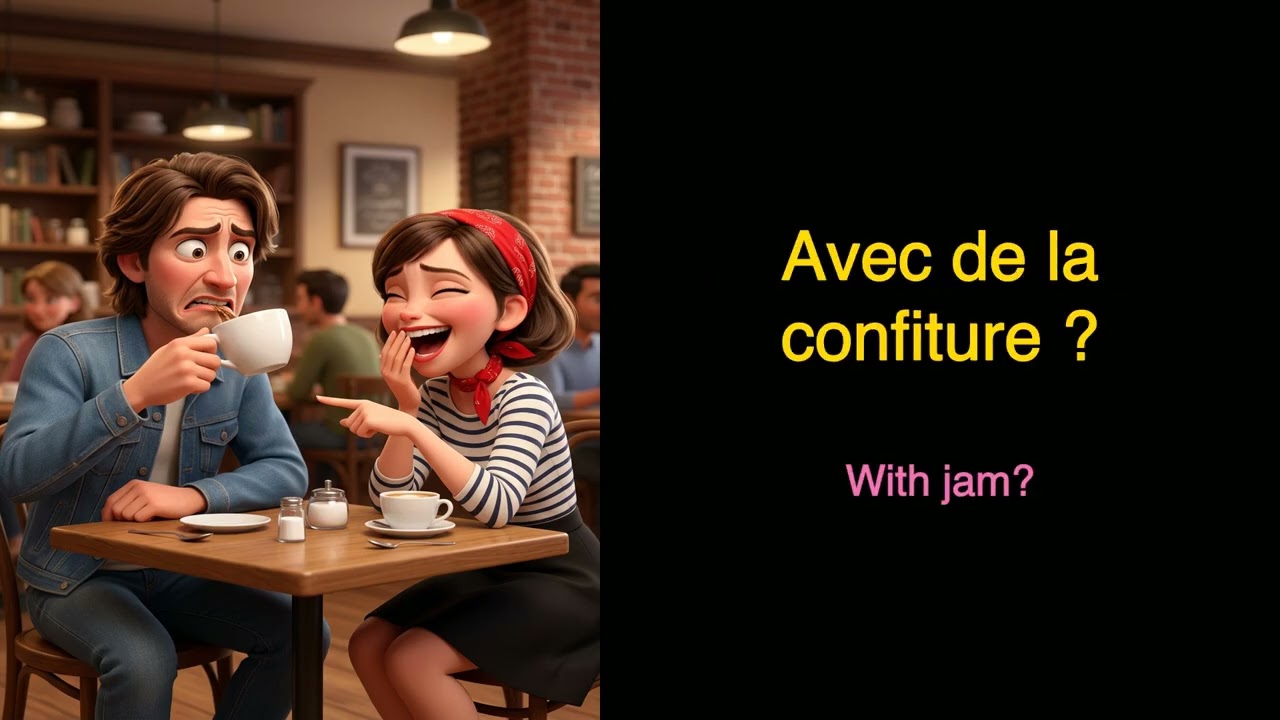
Chloé: Parfait. Avec de la confiture ?
(Chloé: Perfect. With jam?)
Léo: Bien sûr ! Avec de la confiture de fraise, ta préférée.
(Léo: Of course! With strawberry jam, your favorite.)
Chloé: Tu es le meilleur, Léo.
(Chloé: You are the best, Léo.)
Léo: Et voilà ! On attend un peu.
(Léo: And there we go! We wait a little.)
Chloé: D’accord. Léo… tu sens quelque chose ?
(Chloé: Okay. Léo… do you smell something?)
Léo: Non, je ne sens rien. Pourquoi ?
(Léo: No, I don’t smell anything. Why?)
Chloé: Ça sent un peu le brûlé, non ? Regarde, il y a de la fumée !
(Chloé: It smells a bit like burning, no? Look, there is smoke!)
Léo: De la fumée ? Oh non ! Le pain grillé ! Oh là là… Regarde, Chloé.
(Léo: Smoke? Oh no! The toast! Oh dear… Look, Chloé.)
Chloé: Oh… Le pain est noir. Très, très noir.
(Chloé: Oh… The bread is black. Very, very black.)
Léo: Il est complètement brûlé. Ce n’est plus du pain, c’est du charbon.
(Léo: It is completely burned. It’s no longer bread, it’s coal.)
Chloé: Oui, on ne peut pas manger ça.
(Chloé: Yes, we cannot eat that.)
Léo: Je suis triste. Tout est raté. Le café est salé, le pain est brûlé. Le petit-déjeuner spécial est une catastrophe.
(Léo: I am sad. Everything is ruined. The coffee is salty, the bread is burned. The special breakfast is a disaster.)
Chloé: Mais non, Léo, ne dis pas ça ! L’intention est très gentille. Tu as voulu me faire plaisir, et c’est ça qui est important.
(Chloé: But no, Léo, don’t say that! The intention is very kind. You wanted to make me happy, and that is what’s important.)
Léo: Tu penses ?
(Léo: You think so?)
Chloé: Oui, absolument. Et j’ai une idée pour sauver le petit-déjeuner.
(Chloé: Yes, absolutely. And I have an idea to save the breakfast.)
Léo: Ah oui ? Quelle idée ?
(Léo: Oh yes? What idea?)
Chloé: Est-ce que tu as du jus d’orange ?
(Chloé: Do you have any orange juice?)
Léo: Oui, j’ai une bouteille de jus d’orange dans le frigo.
(Léo: Yes, I have a bottle of orange juice in the fridge.)
Chloé: Super. Et est-ce que tu as des fruits ? Une banane par exemple ?
(Chloé: Super. And do you have any fruit? A banana for example?)
Léo: Oui, j’ai des bananes sur la table.
(Léo: Yes, I have bananas on the table.)
Chloé: Parfait ! On peut boire un verre de jus d’orange et manger une banane. C’est un petit-déjeuner simple, mais c’est très bon.
(Chloé: Perfect! We can drink a glass of orange juice and eat a banana. It’s a simple breakfast, but it’s very good.)
Léo: Un jus d’orange et une banane ? Ce n’est pas un petit-déjeuner spécial.
(Léo: An orange juice and a banana? That’s not a special breakfast.)
Chloé: Si, c’est spécial. C’est spécial parce que nous le partageons ensemble.
(Chloé: Yes, it is special. It’s special because we are sharing it together.)
Léo: Tu as raison, Chloé. C’est une très bonne idée.
(Léo: You are right, Chloé. It’s a very good idea.)
Chloé: Allez, viens. On s’installe à table.
(Chloé: Come on. Let’s sit at the table.)
Léo: D’accord. Voilà ton verre de jus et ta banane.
(Léo: Okay. Here is your glass of juice and your banana.)
Chloé: Merci pour ce super petit-déjeuner, Léo !
(Chloé: Thank you for this great breakfast, Léo!)
Léo: De rien, Chloé !
(Léo: You’re welcome, Chloé!)
📝 Essential Vocabulary (Vocabulaire essentiel)
| Target Language | English Translation | Pronunciation |
|---|---|---|
| Le petit-déjeuner | Breakfast | |
| Le sucre | Sugar | |
| Le sel | Salt | |
| Le pain grillé | Toast (grilled bread) | |
| La confiture | Jam | |
| Le frigo | Fridge | |
| Brûlé | Burned | |
| Une catastrophe | A disaster / A catastrophe |
🔍 Grammar Focus (Point de grammaire)
Partitive Articles for Food and Drink
In French, when you want to express the idea of “some” or an unspecific quantity of food and drink, you must use partitive articles (du, de la, de l’, des). You cannot simply state the noun by itself like you can in English.
- du (for masculine singular nouns)
- de la (for feminine singular nouns)
- des (for plural nouns)
Look at how Léo and Chloé use these when talking about the breakfast ingredients:
- “Tu veux du sucre dans ton café ?” (Do you want some sugar in your coffee?)
- “C’est du sel !” (It’s salt!)
- “Avec de la confiture ?” (With some jam?)
- “Est-ce que tu as du jus d’orange ?” (Do you have some orange juice?)
The Versatile Pronoun “Ça”
You will hear the word ça (meaning “that” or “it”) constantly in spoken French. It’s a casual, practical pronoun used to simplify sentences in everyday conversation.
- “Ça va ?” (How is it going?)
- “Ça arrive.” (That happens / It happens.)
- “Ça sent un peu le brûlé, non ?” (It smells a bit like burning, no?)
🌍 Cultural Tip (Conseil culturel)
🃏 Flip & Learn (Cartes mémoires)
Breakfast
Le petit-déjeuner
Sugar
Le sucre
Salt
Le sel
Toast
Le pain grillé
It happens
Ça arrive
💡 Key Takeaways (Points à retenir)
- Food Vocabulary: Make sure you know the difference between le sel (salt) and le sucre (sugar) to avoid a breakfast catastrophe!
- Partitive Articles: Remember to use du (masculine) and de la (feminine) when offering “some” of an uncountable food or drink.
- Everyday Apologies: If you make a mistake, you can say Je suis désolé (I am sorry) or simply Pardon (Sorry/Excuse me).
- Reassuring someone: If a friend makes an error, you can comfort them by saying Ce n’est pas grave (It’s no big deal) or Ça arrive (It happens).
🎯 Practice Quiz (Quiz de pratique)
Question
Question
Question
✍️ Fill in the Blanks (Remplissez les blancs)
Let’s test your spelling and memory! Fill in the missing words below. Use correct spelling.
Fill in the blank
Fill in the blank
Support Us
Did you find this lesson helpful? Your support is what makes it possible for us to keep creating free, high-quality educational content.