Talking About Food in French: Shopping List Dialogue & Vocabulary 🛒
Learn essential French vocabulary for food and shopping by following a simple story about a missing shopping list. Perfect for A1 beginners.
In this A1 French lesson, you’ll learn practical vocabulary for everyday situations like grocery shopping. We’ll follow a short story about Léo, who has lost his shopping list, and his friend Chloé, who helps him create a new one. This is a great way to see common French words and phrases in action!
💬 Video Transcript
Chloé (narrating): Bonjour, je m’appelle Chloé. Je suis l’amie de Léo. Aujourd’hui, je suis chez lui. Léo a un problème. Il veut aller au supermarché, mais il ne trouve pas sa liste de courses.
(Chloé (narrating): Hello, my name is Chloé. I am Léo’s friend. Today, I am at his place. Léo has a problem. He wants to go to the supermarket, but he can’t find his shopping list.)
Léo: Oh non ! Où est ma liste ?
(Léo: Oh no! Where is my list?)
Chloé (narrating): Il regarde sur la table. Il regarde dans son sac. Rien. Il est un peu inquiet.
(Chloé (narrating): He looks on the table. He looks in his bag. Nothing. He is a little worried.)
Chloé: Ne t’inquiète pas, Léo. C’est simple. On va faire une nouvelle liste ensemble.
(Chloé: Don’t worry, Léo. It’s simple. We’ll make a new list together.)
Chloé (narrating): Je prends un papier et un stylo. Je demande :
(Chloé (narrating): I take a piece of paper and a pen. I ask:)
Chloé: Qu’est-ce que tu veux manger cette semaine ?
(Chloé: What do you want to eat this week?)
Léo: Hmm… Je veux faire une salade.
(Léo: Hmm… I want to make a salad.)
Chloé: D’accord.
(Chloé: Okay.)
Chloé (narrating): Et j’écris sur le papier : salade, tomates, concombres.
(Chloé (narrating): And I write on the paper: lettuce, tomatoes, cucumbers.)
Chloé: Et pour le petit-déjeuner ?
(Chloé: And for breakfast?)
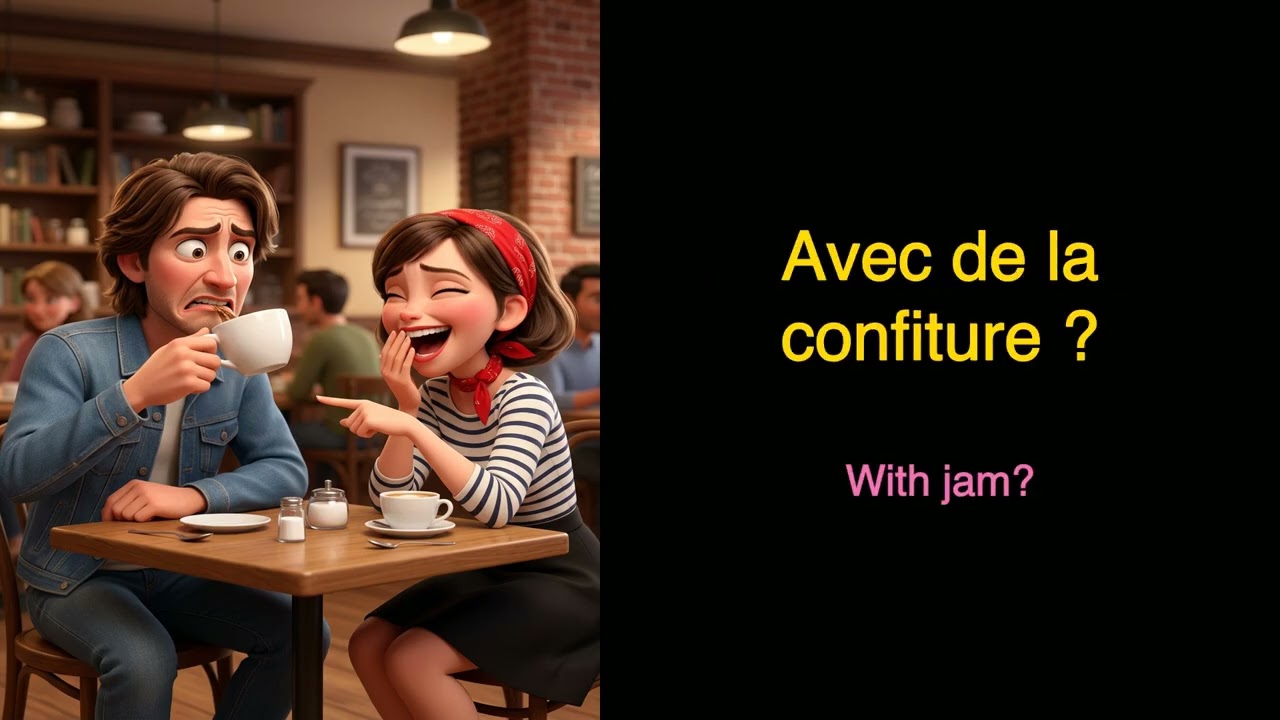
Léo: Du pain et de la confiture !
(Léo: Some bread and some jam!)
Chloé (narrating): J’écris : pain, confiture. Je continue :
(Chloé (narrating): I write: bread, jam. I continue:)
Chloé: Tu aimes les fruits ?
(Chloé: Do you like fruits?)
Léo: Oui ! Des pommes et des bananes, s’il te plaît.
(Léo: Yes! Some apples and some bananas, please.)
Chloé (narrating): J’écris ‘pommes’ et ‘bananes’ sur la liste. Voilà ! En deux minutes, la liste est prête. Elle est courte et claire. C’est pratique.
(Chloé (narrating): I write ‘apples’ and ‘bananas’ on the list. There! In two minutes, the list is ready. It is short and clear. It’s practical.)
Léo: Merci Chloé ! Tu es très intelligente. C’est parfait !
(Léo: Thank you Chloé! You are very smart. It’s perfect!)
Chloé (narrating): Maintenant, il peut aller au supermarché. Problème résolu !
(Chloé (narrating): Now, he can go to the supermarket. Problem solved!)
📝 Essential Vocabulary
Here are some of the key words and phrases from the video. Listen to the pronunciation to improve your accent.
| Target Language | English Translation | Pronunciation |
|---|---|---|
| une liste de courses | a shopping list | |
| le supermarché | the supermarket | |
| il ne trouve pas | he doesn’t find | |
| inquiet | worried | |
| ne t’inquiète pas | don’t worry | |
| le petit-déjeuner | breakfast | |
| la confiture | jam / preserves | |
| les fruits | fruits | |
| pratique | practical / handy | |
| problème résolu | problem solved |
🔍 Grammar Focus
Let’s look at two important grammar points from the dialogue that are essential for beginners.
1. Possessive Adjectives: Ma and Sa
In French, the word for “my” or “his/her” changes depending on the gender of the noun it describes. In the story, you see two examples:
- « Où est ma liste ? » (Where is my list?)
- « …il ne trouve pas sa liste de courses. » (…he can’t find his shopping list.)
The word liste is a feminine noun (une liste). Therefore, we use the feminine possessive adjectives ma (my) and sa (his/her).
- ma liste (my list)
- ta liste (your list)
- sa liste (his/her list)
If the noun were masculine, like sac (bag), you would use the masculine forms: mon sac, ton sac, son sac.
2. The Partitive Articles: Du, De la, Des
When Léo talks about food he wants, he doesn’t specify an exact quantity. He just wants “some” of it. In French, you use partitive articles for this.
- « Du pain et de la confiture ! » (Some bread and some jam!)
- « Des pommes et des bananes… » (Some apples and some bananas…)
The article you use depends on the noun’s gender and number:
- Du is used for masculine singular nouns (le pain -> du pain).
- De la is used for feminine singular nouns (la confiture -> de la confiture).
- Des is used for plural nouns (les pommes -> des pommes).
This is how you say you want an unspecified amount of something, which is very common when making a shopping list!
🌍 Cultural Tip
🃏 Flip & Learn
Use these flashcards to test your memory of key phrases from the story.
A shopping list
Une liste de courses
Don't worry
Ne t'inquiète pas
What do you want to eat?
Qu'est-ce que tu veux manger ?
Problem solved!
Problème résolu !
💡 Key Takeaways
Here are the most important points to remember from this lesson:
- Shopping Vocabulary: You learned essential words for food shopping, including la liste de courses, le supermarché, and names of common foods like tomates, pain, pommes, and bananes.
- Possessive Adjectives: Remember that words like “my” and “his” must agree in gender with the noun they describe (e.g., ma liste, son sac).
- Partitive Articles: Use du, de la, and des to talk about an unspecified quantity of an item, like “some bread” (du pain).
- Asking Questions: The phrase « Qu’est-ce que… ? » is a very common way to ask “What…?” in French.
🎯 Practice Quiz
Check your understanding with a few questions based on the dialogue.
Question
Question
Question
✍️ Fill in the Blanks
Let’s test your spelling and memory! Fill in the missing words below. Use correct spelling.
Fill in the blank
Fill in the blank
Support Us
Did you find this lesson helpful? Your support is what makes it possible for us to keep creating free, high-quality educational content.