Talking About Breakfast in French: Kitchen Dialogue & Prepositions 🍞
Practice essential A1 French vocabulary for food and kitchen items with this slow dialogue. Learn how to say you're hungry, ask where things are, and describe locations.
In this beginner French lesson, you’ll join Léo on a desperate search for his breakfast. This simple, slow dialogue is perfect for A1 learners to practice essential vocabulary for food, kitchen items, and prepositions of place like “in” and “on”. Listen closely to learn how to ask for help and find things around the house!
💬 Video Transcript
Léo: Chloé ! Chloé ! J’ai besoin de ton aide !
(Léo: Chloé! Chloé! I need your help!)
Chloé: Bonjour Léo. Qu’est-ce qui se passe ? Tu as un problème ?
(Chloé: Hello Léo. What’s going on? Do you have a problem?)
Léo: Bonjour Chloé. Oui, j’ai un grand problème. J’ai faim. J’ai très, très faim.
(Léo: Hello Chloé. Yes, I have a big problem. I’m hungry. I’m very, very hungry.)
Chloé: Ah, tu as faim. Ce n’est pas un grand problème, Léo. Tu veux manger ?
(Chloé: Ah, you’re hungry. That’s not a big problem, Léo. Do you want to eat?)
Léo: Oui, je veux manger. Pour mon petit-déjeuner, je veux du pain grillé.
(Léo: Yes, I want to eat. For my breakfast, I want some toast.)
Chloé: Du pain grillé ? C’est une bonne idée. C’est facile.
(Chloé: Toast? That’s a good idea. That’s easy.)
Léo: Non, ce n’est pas facile ! Je ne trouve pas le pain.
(Léo: No, it’s not easy! I can’t find the bread.)
Chloé: Tu ne trouves pas le pain ? Cherche dans la cuisine.
(Chloé: You can’t find the bread? Look in the kitchen.)
Léo: Je suis dans la cuisine. Je regarde partout. Où est le pain ?
(Léo: I am in the kitchen. I’m looking everywhere. Where is the bread?)
Chloé: Regarde sur la table, Léo.
(Chloé: Look on the table, Léo.)
Léo: Je regarde sur la table. Il y a une pomme. Il y a un verre. Mais il n’y a pas de pain.
(Léo: I’m looking on the table. There is an apple. There is a glass. But there is no bread.)
Chloé: D’accord. Le pain n’est pas sur la table. Regarde dans le placard.
(Chloé: Okay. The bread is not on the table. Look in the cupboard.)
Léo: Le placard ? Bonne idée. J’ouvre le placard… Ah ! Le pain ! Il est ici !
(Léo: The cupboard? Good idea. I’m opening the cupboard… Ah! The bread! It is here!)
Chloé: Super ! Tu as trouvé le pain.
(Chloé: Great! You found the bread.)
Léo: Oui ! Merci Chloé. J’ai le pain. Maintenant, je peux faire mon pain grillé.
(Léo: Yes! Thanks Chloé. I have the bread. Now, I can make my toast.)
Chloé: Parfait. Bon appétit, Léo.
(Chloé: Perfect. Enjoy your meal, Léo.)
Léo: Attends ! J’ai un autre problème.
(Léo: Wait! I have another problem.)
Chloé: Un autre problème ? Qu’est-ce que c’est ?
(Chloé: Another problem? What is it?)
Léo: Je cherche le beurre. Je ne trouve pas le beurre.
(Léo: I’m looking for the butter. I can’t find the butter.)
Chloé: D’accord. Où est-ce que tu cherches le beurre ?
(Chloé: Okay. Where are you looking for the butter?)
Léo: Je cherche dans le placard, avec le pain. Mais le beurre n’est pas dans le placard.
(Léo: I’m looking in the cupboard, with the bread. But the butter is not in the cupboard.)
Chloé: Non, Léo. Le beurre n’est pas dans le placard. C’est normal.
(Chloé: No, Léo. The butter is not in the cupboard. That’s normal.)
Léo: Alors, où est le beurre ? J’ai besoin de beurre pour mon pain grillé.
(Léo: So, where is the butter? I need butter for my toast.)
Chloé: Léo, pense un peu. Où est-ce qu’on met le beurre ? C’est froid.
(Chloé: Léo, think a little. Where do we put the butter? It’s cold.)
Léo: Froid ? Ah ! Dans le frigo ?
(Léo: Cold? Ah! In the fridge?)
Chloé: Oui ! Exactement. Regarde dans le frigo.
(Chloé: Yes! Exactly. Look in the fridge.)
Léo: J’ouvre le frigo. Je regarde… Oui ! Le beurre est ici ! À côté du lait.
(Léo: I’m opening the fridge. I’m looking… Yes! The butter is here! Next to the milk.)
Chloé: Très bien. Tu vois, ce n’est pas difficile.
(Chloé: Very good. You see, it’s not difficult.)
Léo: Merci Chloé. J’ai le pain. J’ai le beurre. C’est super.
(Léo: Thanks Chloé. I have the bread. I have the butter. That’s great.)
Chloé: De rien, Léo. Maintenant, tu as tout ?
(Chloé: You’re welcome, Léo. Now, do you have everything?)
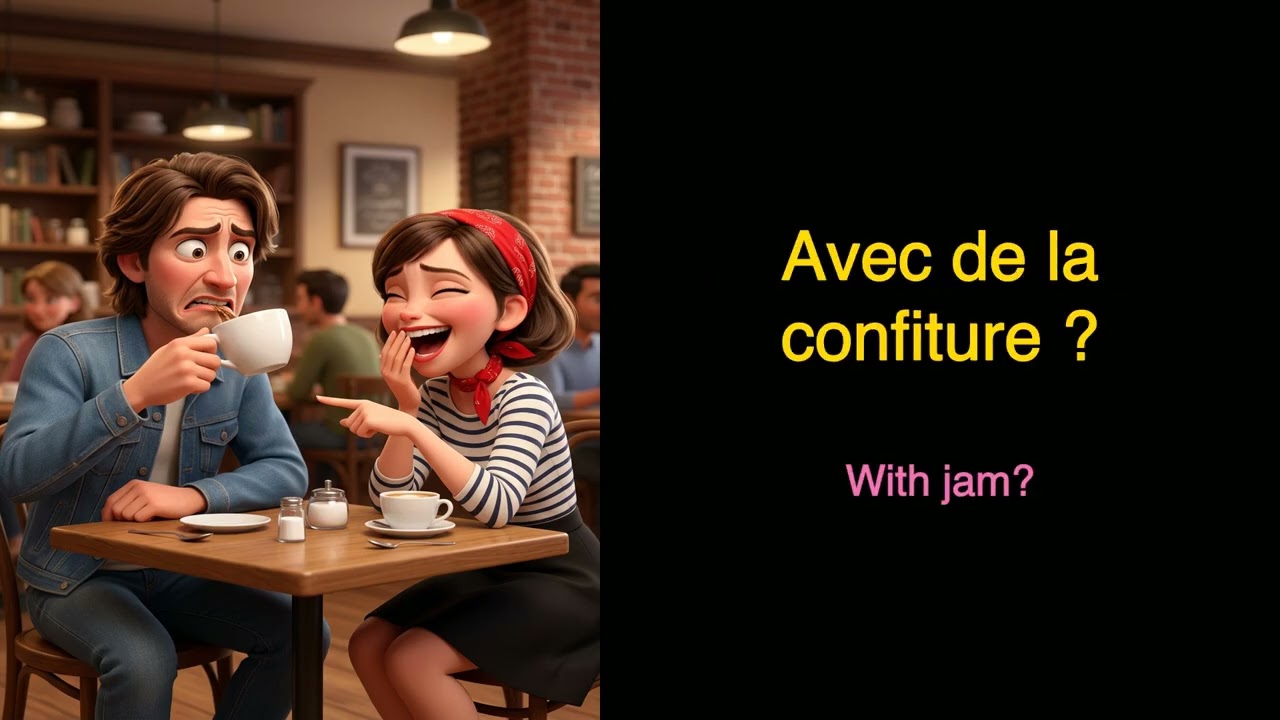
Léo: Hmm… J’ai le pain. J’ai le beurre. C’est bien. Mais… je veux de la confiture.
(Léo: Hmm… I have the bread. I have the butter. That’s good. But… I want some jam.)
Chloé: Tu veux de la confiture ? Quelle confiture ?
(Chloé: You want jam? What kind of jam?)
Léo: Je veux de la confiture de fraise. C’est ma préférée. Mais… où est la confiture ?
(Léo: I want strawberry jam. It’s my favorite. But… where is the jam?)
Chloé: Oh, Léo… Cherche la confiture.
(Chloé: Oh, Léo… Look for the jam.)
Léo: D’accord, je cherche. La confiture n’est pas sur la table. Elle n’est pas dans le placard.
(Léo: Okay, I’m looking. The jam is not on the table. It is not in the cupboard.)
Chloé: Léo, où est-ce que tu as trouvé le beurre ?
(Chloé: Léo, where did you find the butter?)
Léo: J’ai trouvé le beurre dans le frigo.
(Léo: I found the butter in the fridge.)
Chloé: Alors, peut-être que la confiture est aussi dans le frigo ?
(Chloé: So, maybe the jam is also in the fridge?)
Léo: C’est possible ! Je regarde encore dans le frigo. Ah ! Oui ! La confiture est là ! Juste à côté du beurre !
(Léo: It’s possible! I’m looking in the fridge again. Ah! Yes! The jam is there! Right next to the butter!)
Chloé: Bravo Léo ! Tu as trouvé la confiture tout seul !
(Chloé: Bravo Léo! You found the jam all by yourself!)
Léo: Oui ! J’ai le pain. J’ai le beurre. Et j’ai la confiture de fraise. Mon petit-déjeuner est parfait !
(Léo: Yes! I have the bread. I have the butter. And I have the strawberry jam. My breakfast is perfect!)
Chloé: Je suis contente pour toi, Léo.
(Chloé: I’m happy for you, Léo.)
Léo: Merci beaucoup pour ton aide, Chloé. Tu es la meilleure.
(Léo: Thank you very much for your help, Chloé. You’re the best.)
Chloé: De rien. C’est normal. Alors, bon petit-déjeuner.
(Chloé: You’re welcome. It’s normal. So, enjoy your breakfast.)
Léo: Chloé, attends ! J’ai faim et tu es ici. Tu veux manger du pain grillé avec moi ?
(Léo: Chloé, wait! I’m hungry and you are here. Do you want to eat some toast with me?)
Chloé: Du pain grillé avec du beurre et de la confiture de fraise ?
(Chloé: Toast with butter and strawberry jam?)
Léo: Oui ! Exactement.
(Léo: Yes! Exactly.)
Chloé: Oui, Léo. Avec grand plaisir. Maintenant, j’ai faim aussi !
(Chloé: Yes, Léo. With great pleasure. Now I’m hungry too!)
📝 Essential Vocabulary
Here are some key words and phrases from the dialogue that will help you understand the story. Listen to the pronunciation to improve your French accent.
| Target Language | English Translation | Pronunciation |
|---|---|---|
| J’ai faim | I am hungry | |
| Le petit-déjeuner | Breakfast | |
| Le pain grillé | Toast | |
| Chercher | To look for / to search | |
| Trouver | To find | |
| Le placard | The cupboard | |
| Le frigo | The fridge | |
| Le beurre | The butter | |
| La confiture | The jam |
🔍 Grammar Focus
Let’s look at two simple but very important grammar points from the dialogue.
1. Using Prepositions of Place: dans and sur
To say where things are, you need prepositions. In this story, Léo uses two of the most common ones: dans (in) and sur (on).
dansis used for things that are inside a place.- Example from the script: “Regarde dans le placard.” (Look in the cupboard.)
- Example from the script: “Le beurre est dans le frigo.” (The butter is in the fridge.)
suris used for things that are on top of a surface.- Example from the script: “Regarde sur la table, Léo.” (Look on the table, Léo.)
- Example from the script: “Le pain n’est pas sur la table.” (The bread is not on the table.)
Notice how these simple words help Léo and Chloé talk about the location of the breakfast items.
2. Asking “Where?”: Où est...?
When you can’t find something, the most important question is “Where is…?”. In French, you say Où est...?. This phrase is used throughout the dialogue.
The structure is simple: Où (Where) + est (is) + le/la (the) + noun.
- Example from the script: “Où est le pain ?” (Where is the bread?)
- Example from the script: “Alors, où est le beurre ?” (So, where is the butter?)
- Example from the script: “Mais… où est la confiture ?” (But… where is the jam?)
Remember to use le for masculine nouns (le pain, le beurre) and la for feminine nouns (la confiture).
🌍 Cultural Tip
🃏 Flip & Learn
Use these flashcards to test your memory of the key vocabulary from the dialogue.
The breakfast
Le petit-déjeuner
I'm hungry
J'ai faim
The cupboard
Le placard
The fridge
Le frigo
I can't find the bread
Je ne trouve pas le pain
💡 Key Takeaways
Here are the most important points to remember from this lesson:
- To say you are hungry in French, use the expression
avoir faim(to have hunger), as in “J’ai faim.” - Essential breakfast vocabulary includes:
le pain(bread),le beurre(butter), andla confiture(jam). - Use the prepositions
dans(in) andsur(on) to describe the location of objects. - The question
Où est...?is the simplest way to ask “Where is…?” for a specific item. - Many food items that need to be kept cold, like
le beurreandla confiture, are founddans le frigo(in the fridge).
🎯 Practice Quiz
Check your understanding of the dialogue with these questions.
Question
Question
Question
✍️ Fill in the Blanks
Let’s test your spelling and memory! Fill in the missing words below. Use correct spelling.
Fill in the blank
Fill in the blank
Support Us
Did you find this lesson helpful? Your support is what makes it possible for us to keep creating free, high-quality educational content.