Describing Your Morning Routine in French: A Slow vs. Fast Dialogue 🐢🚀
Learn how to describe your morning routine in French with our fun dialogue between Léo the Turtle and Chloé the Rocket. Master essential A1 reflexive verbs and adverbs.
Are you a slow-moving turtle in the morning or a quick rocket? In this lesson for French beginners, you’ll listen to a fun phone call between Léo and Chloé, who have very different morning speeds! You’ll learn essential reflexive verbs for daily routines and adverbs to describe how you do things.
💬 Video Transcript
Chloé: Allô, Léo ? C’est Chloé. Ça va ?
(Chloé: Hello, Léo? It’s Chloé. How are you?)
Léo: … Salut Chloé. Ça va doucement. Et toi ?
(Léo: … Hi Chloé. It’s going slowly. And you?)
Chloé: Moi, ça va très bien ! Je suis pleine d’énergie ! Qu’est-ce que tu fais ?
(Chloé: Me, I’m doing great! I’m full of energy! What are you doing?)
Léo: Moi ? Je suis dans mon lit.
(Léo: Me? I’m in my bed.)
Chloé: Dans ton lit ? Mais Léo, il est neuf heures du matin !
(Chloé: In your bed? But Léo, it’s nine in the morning!)
Léo: Oui, neuf heures. C’est le matin. Pour moi, le matin, c’est lent. Très, très lent.
(Léo: Yes, nine o’clock. It’s the morning. For me, the morning is slow. Very, very slow.)
Chloé: Ah, d’accord. Moi, le matin, je suis rapide. Très, très rapide ! Alors, tu commences ta journée ?
(Chloé: Ah, okay. Me, in the morning, I’m fast. Very, very fast! So, are you starting your day?)
Léo: Oui. D’abord, je me lève. Je me lève lentement.
(Léo: Yes. First, I get up. I get up slowly.)
Chloé: D’accord. Tu te lèves lentement. Et après ? Qu’est-ce que tu fais ?
(Chloé: Okay. You get up slowly. And after? What do you do?)
Léo: Après, je vais dans la cuisine. Je prépare mon petit-déjeuner. Lentement.
(Léo: Afterwards, I go to the kitchen. I prepare my breakfast. Slowly.)
Chloé: Ah ! Le petit-déjeuner ! C’est important. Tu manges quoi ?
(Chloé: Ah! Breakfast! It’s important. What do you eat?)
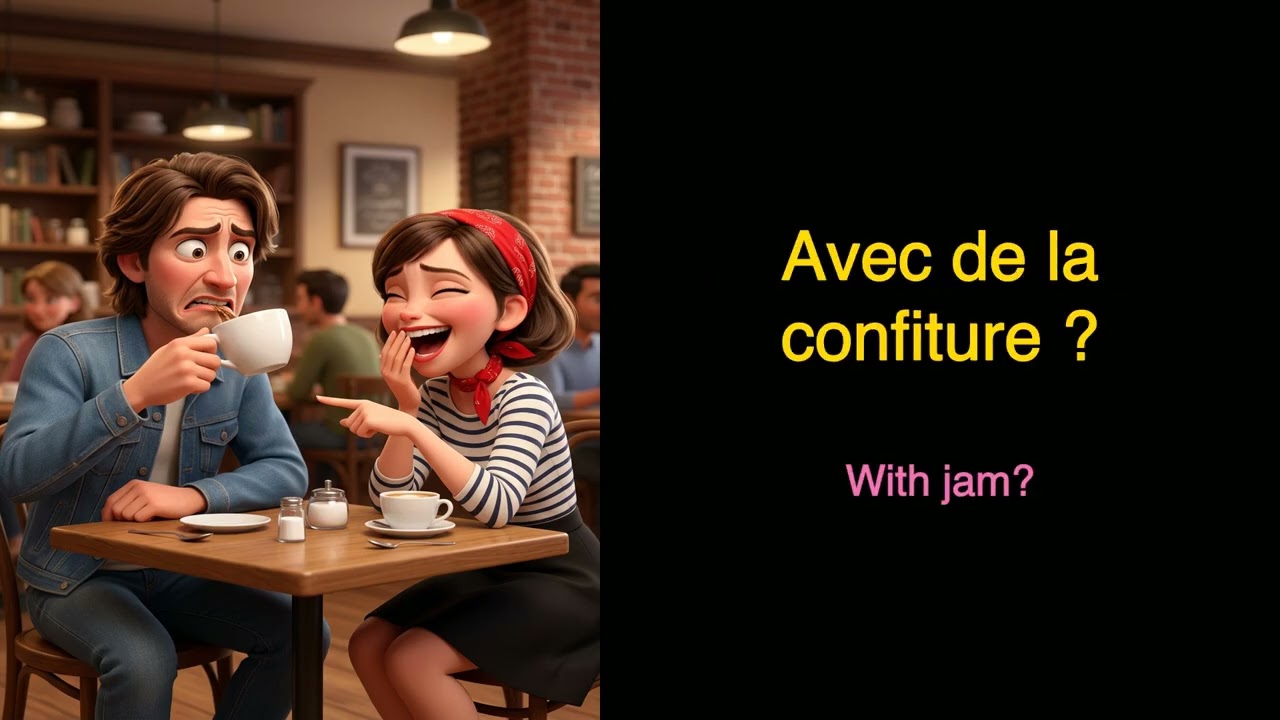
Léo: Je mange une tartine avec de la confiture. Et je bois un grand chocolat chaud.
(Léo: I eat a slice of bread with jam. And I drink a big hot chocolate.)
Chloé: Miam ! C’est bon. Moi, j’ai déjà mangé. J’ai mangé un yaourt et un fruit.
(Chloé: Yum! That’s good. Me, I’ve already eaten. I ate a yogurt and a piece of fruit.)
Léo: Ah. Tu manges vite ?
(Léo: Ah. You eat fast?)
Chloé: Oui, je mange très vite. Et toi, Léo ?
(Chloé: Yes, I eat very fast. And you, Léo?)
Léo: Moi, je mange très, très, très lentement. Je regarde par la fenêtre. Je regarde les oiseaux.
(Léo: Me, I eat very, very, very slowly. I look out the window. I watch the birds.)
Chloé: C’est poétique ! Mais ce n’est pas rapide. Et après ton petit-déjeuner ?
(Chloé: That’s poetic! But it’s not fast. And after your breakfast?)
Léo: Après le petit-déjeuner, je vais dans la salle de bain.
(Léo: After breakfast, I go to the bathroom.)
Chloé: Pour te brosser les dents ?
(Chloé: To brush your teeth?)
Léo: Oui. Je me brosse les dents. Très lentement.
(Léo: Yes. I brush my teeth. Very slowly.)
Chloé: Bien sûr ! Lentement. Comme toujours. Et après les dents ?
(Chloé: Of course! Slowly. As always. And after the teeth?)
Léo: Après, je m’habille.
(Léo: Afterwards, I get dressed.)
Chloé: Super ! Qu’est-ce que tu portes aujourd’hui ?
(Chloé: Great! What are you wearing today?)
Léo: Hmm. Je ne sais pas. Je dois choisir. Un t-shirt bleu ? Un t-shirt rouge ? Un pantalon noir ? Je choisis lentement.
(Léo: Hmm. I don’t know. I have to choose. A blue t-shirt? A red t-shirt? Black pants? I choose slowly.)
Chloé: Léo ! C’est incroyable. Moi, je suis déjà habillée. J’ai un pull jaune et un jean. C’est rapide !
(Chloé: Léo! That’s unbelievable. Me, I’m already dressed. I have a yellow sweater and jeans. That’s fast!)
Léo: Tu es une fusée, Chloé.
(Léo: You are a rocket, Chloé.)
Chloé: Et toi, tu es une tortue, Léo !
(Chloé: And you, you are a turtle, Léo!)
Léo: C’est vrai. Je suis une tortue le matin. Bonjour, je suis Léo la tortue.
(Léo: It’s true. I’m a turtle in the morning. Hello, I am Léo the turtle.)
Chloé: C’est très drôle ! Bon, Léo la tortue, tu es prêt dans combien de temps ?
(Chloé: That’s very funny! Okay, Léo the turtle, when will you be ready?)
Léo: Hmm… Je suis prêt… à midi.
(Léo: Hmm… I’ll be ready… at noon.)
Chloé: À midi ! Parfait. On peut aller au parc à midi ?
(Chloé: At noon! Perfect. Can we go to the park at noon?)
Léo: Oui ! C’est une excellente idée. J’aime le parc.
(Léo: Yes! That’s an excellent idea. I love the park.)
Chloé: Super ! Alors, rendez-vous à midi au parc. Prends ton temps, Léo !
(Chloé: Great! So, see you at noon at the park. Take your time, Léo!)
Léo: Promis ! Merci Chloé. À tout à l’heure, la fusée !
(Léo: I promise! Thanks Chloé. See you later, rocket!)
Chloé: À tout à l’heure, la tortue !
(Chloé: See you later, turtle!)
📝 Essential Vocabulary
| Target Language | English Translation | Pronunciation |
|---|---|---|
| lentement | slowly | |
| rapidement / vite | quickly / fast | |
| le petit-déjeuner | breakfast | |
| se lever | to get up | |
| s’habiller | to get dressed | |
| se brosser les dents | to brush one’s teeth | |
| une tartine | a slice of bread (with spread) | |
| une fusée | a rocket | |
| une tortue | a turtle | |
| à tout à l’heure | see you later (today) |
🔍 Grammar Focus
Reflexive Verbs for Daily Routines
In French, many verbs describing actions you do to yourself are “reflexive.” You can spot them by the se in front of the infinitive, like se lever (to get up). When you use them, you need a reflexive pronoun (me, te, se, etc.) that matches the subject.
Notice how Léo uses them to describe his morning:
- Je
melève lentement. (I get up slowly.) - Je
mebrosse les dents. (I brush my teeth.) - Après, je
m'habille. (Afterwards, I get dressed.)
Chloé also uses one when asking Léo a question:
- Pour
tebrosser les dents ? (To brush your teeth?) - Here,tematchestu(you).
Adverbs of Manner: lentement and rapidement
To describe how an action is done, you can use an adverb. In this dialogue, Léo and Chloé use adverbs to describe their different speeds. Many French adverbs are formed by adding -ment to the feminine form of an adjective.
lent(slow) ->lente(feminine) ->lentement (slowly)rapide(fast) ->rapide(feminine) ->rapidement (quickly)
Examples from the script:
- Je me lève lentement. (I get up slowly.)
- Moi, je mange très, très, très lentement. (Me, I eat very, very, very slowly.)
- C’est rapide ! (That’s fast!) - Here,
rapideis an adjective describing “that”. Chloé also usesvite, which is another common adverb for “fast”: “Oui, je mange très vite.”
🌍 Cultural Tip
une tartine avec de la confiture (a slice of bread with jam) and a chocolat chaud (hot chocolate) is a very traditional French breakfast, or petit-déjeuner. Unlike savory breakfasts common in other countries, the French often prefer a simple, sweet start to the day, frequently involving a baguette, croissants, jam, and a hot drink like coffee or hot chocolate.🃏 Flip & Learn
To get up
Se lever
Slowly
Lentement
Breakfast
Le petit-déjeuner
See you later!
À tout à l'heure !
To get dressed
S'habiller
💡 Key Takeaways
- Use reflexive verbs like
se lever,se brosser les dents, ands'habillerto talk about your personal daily routine. - Describe the speed of your actions with the adverbs
lentement(slowly) andrapidementorvite(quickly). - You can use fun animal and object names like
la tortue(the turtle) andla fusée(the rocket) as playful nicknames. - Remember “Qu’est-ce que tu fais ?” to ask “What are you doing?”.
- “À tout à l’heure” is a great way to say “See you later” when you know you’ll see the person again on the same day.
🎯 Practice Quiz
Question
Question
Question
✍️ Fill in the Blanks
Let’s test your spelling and memory! Fill in the missing words below. Use correct spelling.
Fill in the blank
Fill in the blank
Support Us
Did you find this lesson helpful? Your support is what makes it possible for us to keep creating free, high-quality educational content.