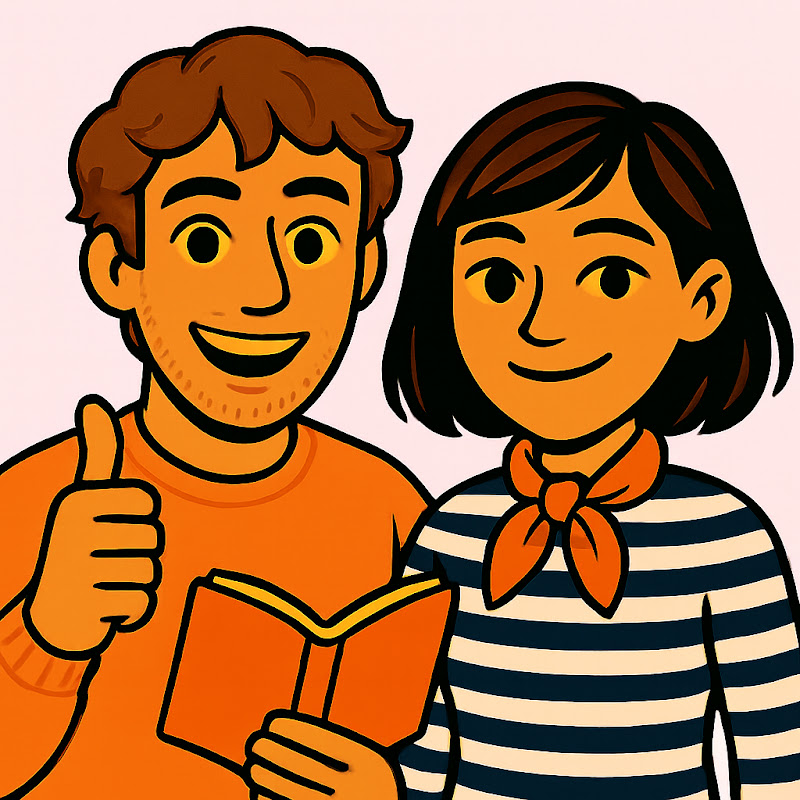
Galette des rois and Chandeleur: n'importe quoi, chacun, tous les ans 👑
Share a galette des rois the French way: say who gets each slice, tell someone to pick any slice, crown a king, and talk about when Epiphany and Candlemas happen every year.
- Lesson 1 of 42 in this unit
- Elementary · A2 — Simple conversations and everyday topics
- Core — a must-do lesson, on every path

👑 A galette, and a boyfriend with a plan
January, at Léo’s parents’ flat in the 5th arrondissement. Camille comes out of the kitchen with a round golden cake, still warm. The pastry has a pattern of leaves cut into the top. She’s a pastry chef, so of course it’s perfect.
Léo stands up like it’s a ceremony.
La galette des rois
is the cake of early January: puff pastry with almond cream inside, and somewhere in it, a tiny hidden charm. Tirer les rois
, “to draw the kings”, means sharing it to find out who gets the charm. That person becomes king or queen for the evening.
And Léo had a little smile I know very well. A smile that means a plan.
Camille said tous les ans. You can also say chaque année. Both mean “every year”. Here is the trap: an and année both mean “year”, but after chaque you always use année. “Chaque an” is not French. With tous les, it’s ans.
So: tous les ans or chaque année. Two partners, never mixed.
Tous les ans, on tire les rois.
Every year, we draw the kings.
Link the s of les to ans: too lay ZAHN.
Fill in the blank
🥧 One slice too many
Léo takes the knife. Camille, Philippe, Léo, me: four people. He cuts five slices. He puts the fifth one on a small ceramic plate and sets it apart.
I counted the slices again. Inside each one: la frangipane
, the soft almond cream. My favourite part, honestly.
| Word | Meaning | Notes | Listen |
|---|---|---|---|
| une part | a slice, a share | PAR | |
| la part du pauvre | the poor person’s slice, kept aside | lah PAR dew POHV-ruh | |
| la part du bon Dieu | God’s share, the same extra slice | lah PAR dew bohn DYUH | |
| une part de frangipane | a slice of almond-cream galette | ewn PAR duh frahn-zhee-PAN | |
| l’Épiphanie | Epiphany, January 6th | lay-pee-fah-NEE · also called la fête des Rois |

🤔 “Any slice you want…”
Then Léo pushed the plate towards me, very slowly, with that smile.
Any slice. Right. But one slice was turned a little towards me. A tiny, tiny bit.
He definitely looked.
N'importe means “it doesn’t matter”. Put a question word after it and you get English “any”:
n'importe quelle part= any slicen'importe qui= anyonen'importe quoi= anything, and very often: nonsense
Watch out with “any + noun”: quel agrees with the noun. Part is feminine, so n'importe quelle part. A masculine noun takes quel: n'importe quel gâteau. Plural: quels, quelles. In speech they all sound the same, KEL, so the spelling is where you must think.
Choisis n'importe quelle part ! Pick any slice! n'importe is one sound block: nam-PORT, the e at the end is silent. Ne dis pas n'importe quoi ! Don't talk nonsense! Push a little on KWAH, like you're teasing someone.
Quick check
🙈 Under the table
Camille put her hand flat on the table. In her pâtisserie, nobody argues with that hand.
Traditionally it’s the youngest child who goes under. There were no children. Everyone looked at me. I’m thirty. I sighed… and I went under the table.
From down there, I couldn’t see anything. Léo touched a slice and asked:
And I said a name. Philippe, Camille, Léo, me. Pure luck. Bref, no more plan for Léo.
Chacun means “each one, everyone”, and it stands alone, with no noun after it: chacun reçoit une part. If you talk only about women, it’s chacune. Its partner chaque always comes before a noun: chaque part, chaque invité. English uses “each” for both, French doesn’t.
Chacun reçoit une part.
Everyone gets a slice.
chacun ends through the nose: shah-KUHN, no n sound at the end.
Fill in the blank
🫘 Crunch
I came out from under the table, took my slice, and bit into it. Crunch. Something hard. I took it out: a tiny porcelain croissant, white and gold.
Léo looked so proud, as if he had planned it. He did not plan it. Camille put the gold paper crown on my head.
La fève once meant a real bean. Today it’s a little porcelain figure: la fève en porcelaine. And the queen chooses a king. That’s the rule.
| Word | Meaning | Notes | Listen |
|---|---|---|---|
| la fève | the hidden charm in the galette | lah FEV | |
| la fève en porcelaine | the porcelain charm | lah FEV ahn por-suh-LEN | |
| la couronne dorée | the golden paper crown | lah koo-RON doh-RAY | |
| être couronnée reine | to be crowned queen | koo-roh-NAY REN · for a man: être couronné roi | |
| désigner le roi ou la reine | to choose the king or the queen | day-zee-NYAY luh RWAH oo lah REN |
J'ai la fève !
I've got the charm!
fève rhymes with English 'Bev' with an F.
🥞 Léo is already thinking about crêpes
Before I could choose, Léo was talking about the next party.
I’m from Brittany. Nobody gets the crêpe day wrong in front of me.
The custom: you hold a coin in one hand, flip the crêpe in the pan with the other, and if it lands back in the pan, you’ll have money all year. In Rennes, my father always drops the first one.
| Word | Meaning | Notes | Listen |
|---|---|---|---|
| la Chandeleur | Candlemas, February 2nd, crêpe day | lah shahn-duh-LUR | |
| au début de / du | at the beginning of | oh day-BEW duh · au début du mois | |
| à la fin de / du | at the end of | ah lah FAN duh · à la fin de janvier | |
| à la mi-janvier | in mid-January | ah lah mee-zhahn-VYAY · also à la mi-mai | |
| à l’occasion de | for, on the occasion of | ah loh-kah-ZYOHN duh | |
| lors de | during, at the time of | LOR duh | |
| faire sauter les crêpes | to flip the crêpes in the air | fair soh-TAY lay KREP · en tenant une pièce de monnaie pour la prospérité |
La Chandeleur, c'est le 2 février.
Candlemas is on February 2nd.
Say le deux février, and end Chandeleur through an open 'ur'.
Fill in the blank
🤴 The queen decides
Now everyone was waiting. Philippe pointed at himself, laughing. Camille said, very calmly, “La pâtissière, c’est moi.” Léo just looked at me with big Marseille puppy eyes.
The crown was on my head. The choice was mine. Help me say it.
Quick check
Je choisis Léo. C'est mon roi.
I choose Léo. He's my king.
roi is one quick sound: RWAH.
Léo put on the second paper crown, a bit crooked, and kissed my hand like a real king. Camille rolled her eyes and smiled.
🎯 What you can say now
Tous les ans/chaque année: every year (never “chaque an”).Choisis n'importe quelle part !:quelagrees with the noun.Ne dis pas n'importe quoi !: anything, or nonsense.Chacun reçoit une part.:chacunalone,chaque+ noun.J'ai la fève !andC'est mon roi.La Chandeleur, c'est le 2 février, au début du mois.
Bref, January is for galettes and February for crêpes. And after the winter? On verra bien… but I hear there’s a day in May when people give each other little white flowers for luck.

Back PandaTwin
Léo says: Every lesson you share helps someone find their way into a new language. Thank you for being part of this.