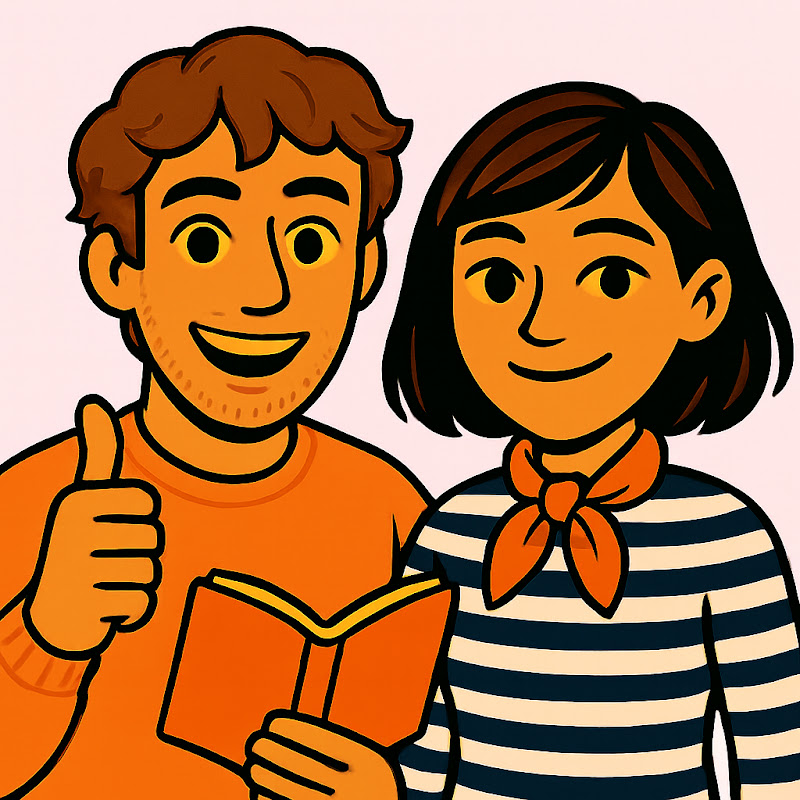
First Words in French: Morning at the Latin Quarter Café ☕
Sit with Chloé and Léo on a sunny Parisian terrace. Decode your first French letters, master everyday café words, and pronounce clean, rhythmic syllables.
- Lesson 1 of 68 in this unit
- Beginner · A1 — First words, greetings, and basic phrases
- Core — a must-do lesson, on every path
Morning light spills across the cobblestones of the Place de la Contrescarpe. The round zinc bistro table is cool beneath my fingers as I pull my sketchbook from my bag, adjusting my striped neckerchief against the autumn chill. Beside me, Léo taps his bus schedule on the table rim, staring impatiently toward the bistro doorway. We have less than an hour before my first studio session at the École des Beaux-Arts and his history lecture at the Sorbonne. We desperately need caffeine.
A dark slate chalkboard hangs right beside the doorway, covered in crisp, looping chalk script.
Can you read the daily chalkboard specials before the waiter comes over to take our order?

📋 What You’ll Learn: Letters a to j
To read a French chalkboard, you only need to recognise the shapes of lowercase letters and know how they sound. French uses the Latin alphabet, just like English, but its lowercase letters have elegant, flowing strokes.
Let’s meet our first team of ten lowercase letters: a, b, c, d, e, f, g, h, i, j.
- a makes an open, bright “ah” sound, wider and more relaxed than in English.
- b sounds very much like the English “b”, but articulated a little more crisply with the lips.
- c before vowels like a, o, or u sounds like a hard “k”, but before e and i it sounds like an “s”.
- d sounds like the English “d”, but your tongue should tap the back of your upper teeth, not the roof of your mouth.
- e makes a soft “uh” sound by default. You will often see it wearing an accent mark like a little tilted hat, which changes its sound.
- f is pronounced exactly like the English “f”, with your top teeth gently resting on your bottom lip.
- g sounds like a hard “g” before a, but before e or i it makes a soft buzzing “zh” sound.
- h is the easiest letter to learn because in French, h is always completely silent!
- i sounds like the “ee” in meet, but shorter and more tense.
- j always makes a soft buzzing “zh” sound, never the hard “j” sound of the English word jump.
Notice the difference between the consonants and vowels: French vowels are pure and steady, while the consonants are articulated crisply at the front of the mouth.
☕ First Sips: Words on the Chalkboard
Now let’s decode the morning drinks written on the slate.
Our first word is café (kah-FEH), which means coffee or café
. Notice the small accent stroke pointing up to the right on the final letter: é. This is called an accent aigu (acute accent). It tells you to pronounce the vowel with a crisp, bright “eh” sound, with your lips pulled into a slight smile.
Next to it on the board is thé (TEH), which means tea
. Because the letter h is always silent in French, you do not say “th” like in English. You pronounce it purely as a clean “t” followed by the bright “é”.
Just behind our table, the number 89 bus (BEWS) rumbles past the square
. In everyday transit words like bus, the final letter s is pronounced clearly with a sharp hiss.
Below the drinks, the chalkboard features a chalk drawing of a small forest doe, labeled biche (BEESH)
. A biche is a female deer, and it is also a sweet, classic French pet name. Look at how it is spelled: every single letter in biche comes directly from the first ten letters you just learned! The combination ch creates a soft “sh” sound.

🎙 Say It Out Loud
Let’s order our morning drinks. Keep both syllables in café crisp and balanced.
Un café et un thé
A coffee and a tea
Say it exactly as you heard it on the page.
Léo leans forward over his empty cup, squinting across the cobblestones at the slate board. He is determined to prove his reading skills before our morning lectures begin.
“Écoute-moi bien,” I tell him, tapping my pencil against the zinc edge. “Look at the chalkboard carefully.”
Léo waves his hand dramatically in true Marseille style. “Du coup, Chloé, look at the specials. Are they serving… a biche for breakfast?”
He pronounces the word with such theatrical disbelief that a student at the next table turns around. At that exact moment, the number 89 bus roars past the corner of the rue Rollin. The rumbling cobblestones vibrate through our table legs. Léo’s paper bus schedule catches the breeze and takes flight. He lunges frantically across the table to snatch it, knocking his elbow into my sketchbook.
“C’est n’importe quoi,” I sigh affectionately, plucking the floating schedule cleanly out of the air. “The biche is the café mascot, Léo. Look at the chalk drawing of the deer. The drinks on special are café and thé.”
Léo catches his breath and grins. “Franchement, a little Mediterranean drama wakes up the terrace better than espresso.”
👂 The Sounds of the Street: Rue vs. Lire
As Léo settles down, we look down at the street sign and our lecture reading lists. These bring us to two essential French sounds: the back-of-the-throat r and the front-of-the-mouth l.
Our terrace sits at the corner of a cobblestone rue (REW), which means street
. The French r does not roll on the tip of the tongue like in Spanish, nor does it pull back like in English. Instead, it is voiced gently at the back of your throat. It feels like a very soft, velvety gargle or a gentle purr.
Léo points to his history notes. “Je dois lire” (zhuh dwah LEER), which means “I have to read”
. In lire, the letter l is produced right at the front of your mouth. The tip of your tongue taps cleanly against the ridge behind your upper front teeth.
🗣️ Feel the Shift
Now practise shifting your tongue from the front of your mouth to the back of your throat.
Je dois lire
I have to read
Say it exactly as you heard it on the page.
🎵 The Rhythm of French: Isochronie Syllabique
There is one golden secret to sounding natural in French from your very first day: syllable timing.
In English, rhythm is stress-timed. We make strong syllables long and squash weak syllables into a blurry “uh” sound. For instance, in English, “coffee” becomes CAW-fee, and “a cup of tea” turns into uh-cuppa-tea.
French never squashes its vowels. Every single syllable receives equal time, equal beat, and full vowel clarity:
ca-fé: two clean, even metronome taps: ca - fé.bis-tro: two pure, crisp beats: bis - tro.
Tap your index finger on your desk like a ticking clock: tap, tap. Neither syllable is rushed, and neither vowel is reduced. Bref, French moves like a steady, elegant march.
The waiter emerges onto the terrace, a round metal tray tucked smartly under his arm. He steps between the zinc tables and stops beside us, waiting with an eyebrow raised.
Léo straightens his jacket and nudges my shoulder. “Allez, on y va! You read the board, Chloé. Let’s place the order.”
I look up at the chalkboard one last time, feeling the steady tap-tap rhythm of the syllables in my mind.
Le Carnet de la Contrescarpe
A 5-round interactive Place de la Contrescarpe terrace scene where learners drag or tap French word tiles onto pulsing targets on the café chalkboard, the rumbling #89 bus, the Rue Rollin street plaque, Léo’s Sorbonne notes, and Chloé’s two-part drink order to the waiter.
🔒 You've reached today's exercise limit. Become a member to keep playing.
♥ Upgrade About a minute · practices this lesson Sign in to play Panda Exercises You played your free exercise. Sign in to keep playing.📖 Let’s Read: The Blackboard at the Contrescarpe
Here is the handwritten text on the café board, along with other words from the street. Read each word aloud, keeping your syllables clean, even, and crisp:
café(coffee)thé(tea)biche(doe / café mascot)bus(bus passing the square)rue(street)lire(to read)
You just decoded your very first real French words straight from a Parisian bistro board and the street!
🃏 Flashcards
Flip these cards to lock in the words from the Contrescarpe terrace.
🎯 Quiz
Test your eye and ear on your new Latin Quarter vocabulary.
Quick check
Quick check
Quick check
Quick check
✍ Fill in the Blanks
Complete our morning exchange at the Place de la Contrescarpe.
Fill in the blank
Fill in the blank
Fill in the blank
📝 Vocabulary
Here is your master reference for the words introduced on the terrace today:
| Word | Meaning | Notes | Listen |
|---|---|---|---|
| café | coffee / café | kah-FEH · Everyday masculine noun; designates both the roast drink and the establishment | |
| thé | tea | TEH · Everyday masculine noun; the letter h is always silent | |
| bus | bus | BEWS · Everyday masculine transit noun; the final s is pronounced | |
| biche | doe / pet name | BEESH · Feminine noun for a female deer; also used as an affectionate nickname | |
| rue | street | REW · Feminine noun; features the r pronounced with friction at the back of the throat | |
| lire | to read | LEER · Core verb; begins with the crisp l made behind the top teeth |
“Un café et un thé,” I tell the waiter with a steady smile.
The waiter gives a short, satisfied nod, scribbles on his pad, and turns back toward the counter. Léo breathes a sigh of relief, sliding his bus schedule into his coat pocket. Across the cobblestones, the Latin Quarter is waking up. We have our table, our drinks are on the way, and the words on the chalkboard are no longer a mystery.
💡 Key Takeaways
- The First Ten Letters: You can visually recognize and decode lowercase a through j, remembering that h is always silent and b faces forward while d faces backward.
- The Sounds of the Latin Quarter: You can pronounce the throat sound in
rueand contrast it cleanly with the forward tongue-tip sound inlire. - Equal Syllable Rhythm: French words like
ca-féandbis-tromarch to equal, steady beats without squashing unstressed vowels.


Back PandaTwin
Your support pays for new lessons, original art, and audio across every course.