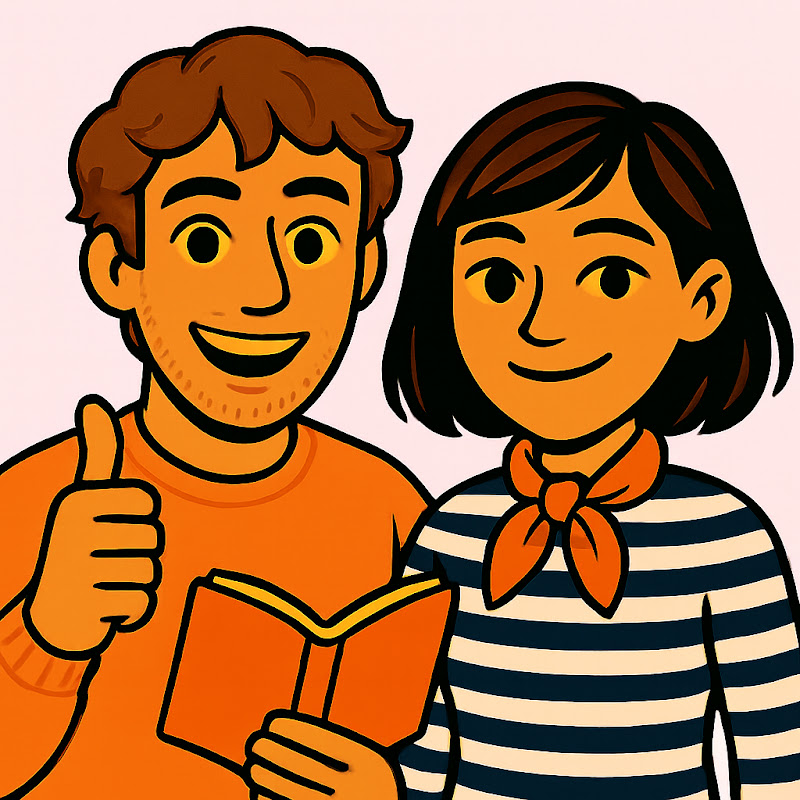
Say Please, Thank You, and Excuse Me in Paris ☕
Master essential French politeness formulas from s'il vous plaît to merci beaucoup, navigate Paris café etiquette, and avoid common beginner traps with Léo.
- Lesson 40 of 68 in this unit
- Beginner · A1 — First words, greetings, and basic phrases
- Core — a must-do lesson, on every path
Bonjour ! I am Léo, and I am delighted to meet you here. Today we master the secret rhythm of French politeness: how to say please, thank you, and excuse me so naturally that any Parisian barista will smile.
Imagine you walk into a crowded Latin Quarter café on a chilly morning, eager for your espresso. What is the very first thing you must say before you even whisper your order?
Right now, I am standing at the shiny zinc counter of a café on Place de la Contrescarpe. The autumn air outside is brisk, my denim jacket sleeves are rolled up, and I miss the warm Mediterranean sun of Marseille. But the roasted coffee smells incredible, and the barista is looking straight at me.

☕ The Sacred Morning Greeting
Before you ask for a single drink, you must perform the opening ritual. In France, walking up to someone and ordering immediately is like serving bouillabaisse without the broth: unthinkable! You always greet the person first.
If you are speaking to a man, you say Bonjour Monsieur
.
If you are speaking to a woman, you say Bonjour Madame
.

🔍 Asking Politely: No Shortcuts
I look the barista in the eye and start our exchange.
When ordering from a server, a shopkeeper, or an elder, you use the formal formula for please: s'il vous plaît
.
With close friends, family, or fellow students, you switch to the casual form: s'il te plaît
.
Here is the big beginner trap: you can never isolate the word plaît on its own. In English, you might shout “Please!”, but in French, saying just plaît makes no sense at all. Franchement, stripping away the rest of the formula sounds like shouting “pleases!” into thin air. Keep the whole phrase intact every single time.
Un café, s'il vous plaît.
A coffee, please.
Keep s'il vous plaît linked together smoothly: seel-voo-PLEH.
Fill in the blank
🥐 Thank You and You’re Welcome
The barista places a hot cup of espresso down on the counter.
To express gratitude warmly, say merci beaucoup
.
The barista replies with the elegant formal response: je vous en prie
. You will discover how the grammar inside this phrase works in a later lesson; for now, treat it as a polite set phrase meaning “you are welcome”.
When talking with friends, you can use the everyday expression de rien
. It literally means “of nothing”, much like saying “it is nothing at all”.
💥 The Counter Incident
I reach eagerly for my cup, but my elbow bumps squarely into the patron standing right beside me at the zinc bar. The ceramic saucer clatters loudly!
When you bump into someone, use pardon
or excusez-moi
.
The gentleman smiles kindly to show no harm was done, asking formal turn-taking reassurance: Ça va bien, merci. Et vous ?
.
Right as I catch my breath, Chloé walks up behind me with her sketchbook and a fresh pastry from Camille’s bakery. She grins at the clattering cup. C'est pas grave.
Notice how Chloé and I switch to the informal pair: Très bien, et toi ?
.
Pardon ! Excusez-moi !
Pardon! Excuse me!
Deliver both with a quick, polite nod: pahr-DOHN, ehk-skew-zay MWAH. For the u in excusez, shape your lips for 'oo' while saying 'ee'.
Au Comptoir en Zinc
'Au Comptoir en Zinc' is a 5-step interactive Parisian zinc-counter story where learners drag or tap French politeness chips into live dialogue bubbles while the café chalkboard rules light up, espresso steams and slides across the bar, a bumped saucer clatters, and Chloé shares a warm croissant.
🔒 You've reached today's exercise limit. Become a member to keep playing.
♥ Upgrade About a minute · practices this lesson Sign in to play Panda Exercises You played your free exercise. Sign in to keep playing.🎯 Your Turn at the Zinc Counter
Now let us return to the opening puzzle. The server turns toward our end of the counter, ready to take the next order.
How do we begin the exchange with proper French respect?
Quick check
Très bien, et toi ?
Very well, and you?
Let your voice rise playfully on toi: treh BYEHN, ay TWAH?
🎲 One Last Look Around the Café
The barista nods with genuine respect and immediately starts pressing the espresso grounds. Let us test your ear on the formulas we discovered today.
Fill in the blank
Quick check
Fill in the blank
📝 Words from the Counter
| Word | Meaning | Notes | Listen |
|---|---|---|---|
| Bonjour Monsieur | hello sir | bohn-ZHOOR muh-SYUH · Formal greeting for any adult man | |
| Bonjour Madame | hello madam | bohn-ZHOOR mah-DAHM · Formal greeting for any adult woman | |
| s’il vous plaît | please | seel voo PLEH · Formal request formula; never shorten to plaît | |
| s’il te plaît | please | seel tuh PLEH · Informal request formula for friends and family | |
| merci beaucoup | thank you very much | mair-SEE boh-KOO · Universal polite thank-you | |
| je vous en prie | you’re welcome | zhuh voo zahn PREE · Elegant formal reply to thanks | |
| de rien | you’re welcome | duh RYEHN · Everyday informal reply to thanks | |
| pardon | excuse me, sorry | pahr-DOHN · Quick apology for physical bumps or passing by | |
| excusez-moi | excuse me | ehk-skew-zay MWAH · Formal apology or attention-getter |
💡 Sunny Marseillais Pride
You can now walk into any French establishment, greet the staff with authentic respect, place an order politely, and apologize smoothly if you bump into someone. You have mastered the social foundation that turns Parisian strangers into friends. Next, you will practice the mandatory commercial opening sequence Bonjour Madame before requesting goods and closing transactions. Allez, on y va !


Back PandaTwin
Your support pays for new lessons, original art, and audio across every course.