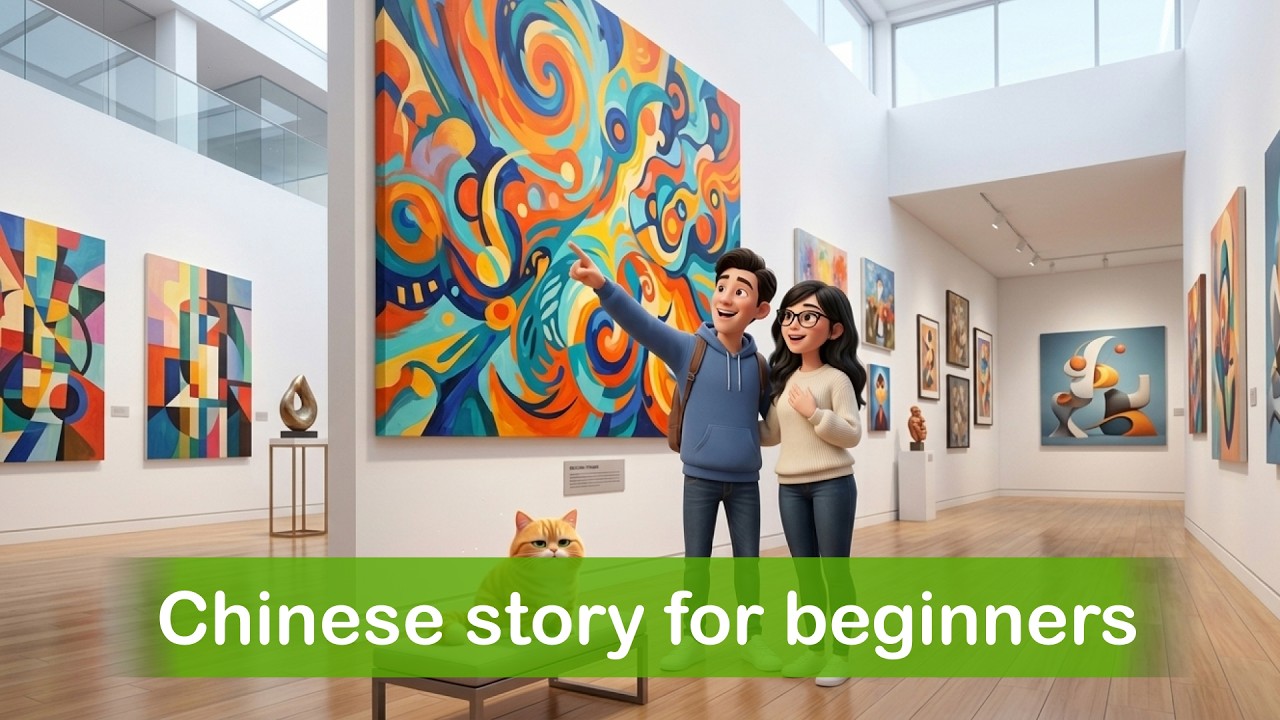
Talking About Family & Pets in Chinese: Photo-Sharing Dialogue 📸
Learn essential Mandarin Chinese vocabulary for family members and pets in this dialogue-based lesson. Practice asking and answering questions about family photos.
In this beginner Mandarin Chinese lesson, you’ll join two friends, Wang Wei and Li Na, as they look through their family photos. You will learn how to introduce your family members, ask who someone is, and talk about whether you have siblings or pets using essential vocabulary and sentence structures.
💬 Video Transcript
王伟: 李娜,你好!
(Wáng Wěi: Hi, Li Na!)
李娜: 王伟,你好!
(Lǐ Nà: Hi, Wang Wei!)
王伟: 你看,这是我的照片。
(Wáng Wěi: Look, this is my photo.)
李娜: 好的,我看看。这是你的家吗?
(Lǐ Nà: Okay, let me see. Is this your family?)
王伟: 是,这是我的家。
(Wáng Wěi: Yes, this is my family.)
李娜: 这是谁?
(Lǐ Nà: Who is this?)
王伟: 这是我爸爸。
(Wáng Wěi: This is my dad.)
李娜: 你爸爸,你好!
(Lǐ Nà: Your dad, hello!)
王伟: 这是我妈妈。
(Wáng Wěi: This is my mom.)
李娜: 你妈妈,你好!她很好看。
(Lǐ Nà: Your mom, hello! She is very good-looking.)
王伟: 谢谢!
(Wáng Wěi: Thanks!)
李娜: 这个人是谁?
(Lǐ Nà: Who is this person?)
王伟: 这个人是我哥哥。他叫王磊。
(Wáng Wěi: This person is my older brother. His name is Wang Lei.)
李娜: 你好,王磊!王伟,你有哥哥,我没有哥哥。
(Lǐ Nà: Hello, Wang Lei! Wang Wei, you have an older brother, I don’t have an older brother.)
王伟: 是的,他是我哥哥。
(Wáng Wěi: Yes, he is my older brother.)
李娜: 哦,看!这是什么?
(Lǐ Nà: Oh, look! What is this?)
王伟: 这是我的猫。
(Wáng Wěi: This is my cat.)
李娜: 你的猫!它叫什么名字?
(Lǐ Nà: Your cat! What is its name?)
王伟: 它叫包子。
(Wáng Wěi: Its name is Bāozi.)
李娜: 包子?哈哈,包子很可爱!
(Lǐ Nà: Bāozi? Haha, Bāozi is very cute!)
王伟: 是,它很可爱。你呢?李娜,这是你的照片吗?
(Wáng Wěi: Yes, it is very cute. And you? Li Na, is this your photo?)
李娜: 是的。你看,这是我的照片。
(Lǐ Nà: Yes. Look, this is my photo.)
王伟: 我看看。这是你的家吗?
(Wáng Wěi: Let me see. Is this your family?)
李娜: 对,这是我的家。
(Lǐ Nà: Correct, this is my family.)
王伟: 这个人是谁?
(Wáng Wěi: Who is this person?)
李娜: 这是我爸爸。
(Lǐ Nà: This is my dad.)
王伟: 你的爸爸,你好!
(Wáng Wěi: Your dad, hello!)
李娜: 这是我妈妈。
(Lǐ Nà: This is my mom.)
王伟: 你的妈妈,你好!
(Wáng Wěi: Your mom, hello!)
李娜: 她们是我的爸爸和妈妈。
(Lǐ Nà: They are my dad and mom.)
王伟: 你有哥哥吗?
(Wáng Wěi: Do you have an older brother?)
李娜: 我没有哥哥。我也没有弟弟。
(Lǐ Nà: I don’t have an older brother. I also don’t have a younger brother.)
王伟: 你没有猫吗?
(Wáng Wěi: You don’t have a cat?)
李娜: 我没有猫。我很喜欢猫。
(Lǐ Nà: I don’t have a cat. I really like cats.)
王伟: 我很喜欢我的猫,包子。
(Wáng Wěi: I really like my cat, Bāozi.)
李娜: 你的家很好。
(Lǐ Nà: Your family is very nice.)
王伟: 谢谢!你的家也很好。
(Wáng Wěi: Thanks! Your family is also very nice.)
李娜: 谢谢你,王伟!
(Lǐ Nà: Thank you, Wang Wei!)
王伟: 不客气!
(Wáng Wěi: You’re welcome!)
📝 Essential Vocabulary
Here are some of the key words and phrases you’ll hear in the video. Listen and repeat to practice your pronunciation!
| Target Language | English Translation | Pronunciation |
|---|---|---|
| 照片 (zhàopiàn) | Photo | |
| 家 (jiā) | Home / Family | |
| 爸爸 (bàba) | Dad / Father | |
| 妈妈 (māma) | Mom / Mother | |
| 哥哥 (gēge) | Older Brother | |
| 猫 (māo) | Cat | |
| 没有 (méiyǒu) | To not have | |
| 可爱 (kě’ài) | Cute / Lovely |
🔍 Grammar Focus
Let’s break down two key grammar patterns from the dialogue.
1. Introducing People and Things with 这是 (zhè shì)
The phrase 这是 (zhè shì) is the fundamental way to say “This is…” in Mandarin. You’ll see it used constantly in the dialogue to introduce family members and pets. The structure is simple:
这是 + (my/your) + Noun
Here are some examples directly from the script:
- 这是我的照片。 (Zhè shì wǒ de zhàopiàn.) - This is my photo.
- 这是我爸爸。 (Zhè shì wǒ bàba.) - This is my dad.
- 这是我的猫。 (Zhè shì wǒ de māo.) - This is my cat.
Notice that when talking about close family members, like 爸爸 (dad) or 妈妈 (mom), the possessive particle 的 (de) is often omitted.
2. Possession with 有 (yǒu) and 没有 (méiyǒu)
To talk about having or not having something, you use the verbs 有 (yǒu) for “to have” and 没有 (méiyǒu) for “to not have.”
To ask a yes/no question, you add the particle 吗 (ma) to the end of a statement.
Subject + 有 + Object + 吗?
- 你有哥哥吗? (Nǐ yǒu gēge ma?) - Do you have an older brother?
- 你没有猫吗? (Nǐ méiyǒu māo ma?) - You don’t have a cat?
To state that you don’t have something, you use 没有 (méiyǒu). Unlike many other verbs, the negative form of 有 is always 没有, not 不有.
- 我没有哥哥。 (Wǒ méiyǒu gēge.) - I don’t have an older brother.
- 我没有猫。 (Wǒ méiyǒu māo.) - I don’t have a cat.
🌍 Cultural Tip
🃏 Flip & Learn
Use these flashcards to test your memory of the key vocabulary from the lesson.
This is my dad.
这是我爸爸。
Older Brother
哥哥
I don't have a cat.
我没有猫。
Very cute
很可爱
What is its name?
它叫什么名字?
💡 Key Takeaways
Here are the most important points to remember from this lesson:
- Use
这是我的 + [noun]to introduce people, places, or things that belong to you (e.g.,这是我的家). - The possessive particle
的 (de)is often dropped when referring to close family members (e.g.,我爸爸instead of我的爸爸). - To ask if someone has something, use the pattern:
你 + 有 + [noun] + 吗?(e.g.,你有哥哥吗?). - The negative form of
有 (yǒu)is always没有 (méiyǒu). Never say不有. - The word
家 (jiā)can mean both “home” and “family” depending on the context.
🎯 Practice Quiz
How much did you learn? Test your knowledge with these questions based on the dialogue.
Question
Question
Question
✍️ Fill in the Blanks
Let’s test your spelling and memory! Fill in the missing words below. Use correct spelling.
Fill in the blank
Fill in the blank
Support Us
Did you find this lesson helpful? Your support is what makes it possible for us to keep creating free, high-quality educational content.