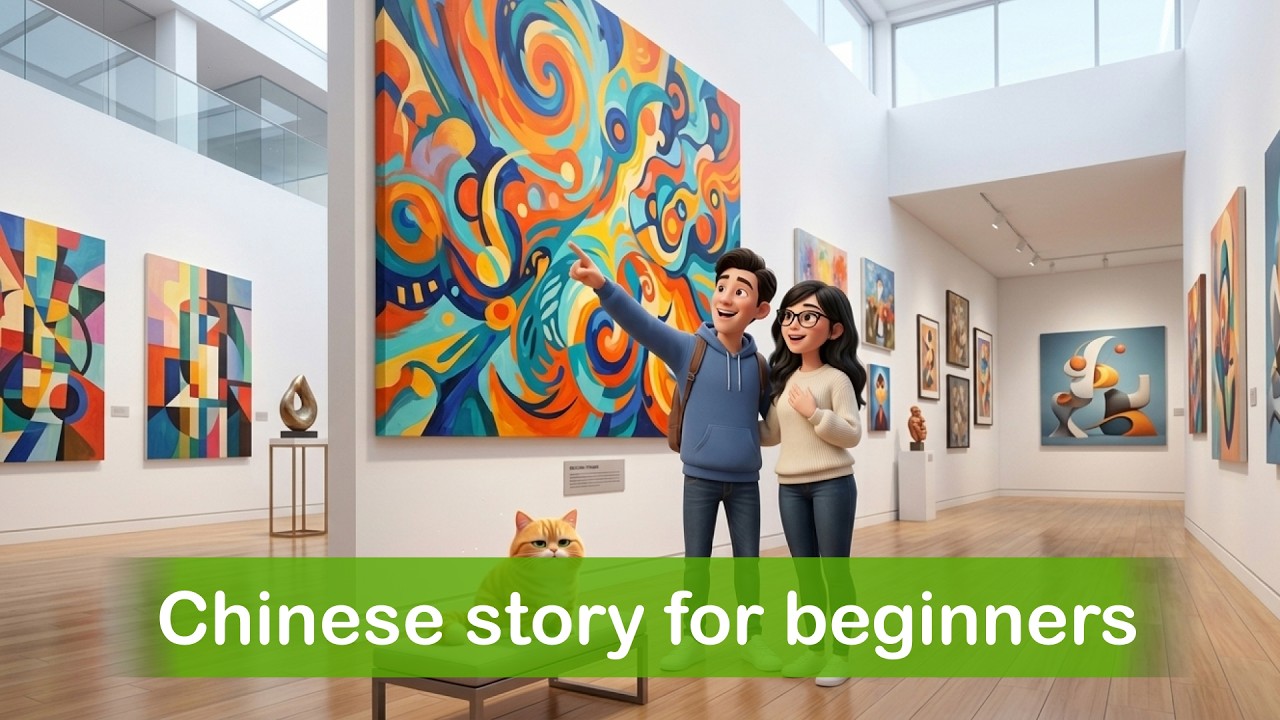
Finding Lost Items in Chinese: Everyday Objects & Location Story 🔑
Learn essential Mandarin Chinese vocabulary for everyday objects and locations with this simple story about a man looking for his keys, hidden by a sleepy cat named Baozi.
In this beginner-level Mandarin Chinese story, you’ll join Wang Lei on a frantic morning search for his keys. This lesson is perfect for learning how to talk about locations and everyday objects, and how to express that something is missing. Pay close attention to how prepositions like “on” and “under” are used!
💬 Video Transcript
王磊: 我是王磊,王伟的哥哥。
(Wang Lei: I am Wang Lei, Wang Wei’s older brother.)
王磊: 今天早上,我要去工作。
(Wang Lei: This morning, I need to go to work.)
王磊: 但是我找不到我的钥匙。
(Wang Lei: But I can’t find my keys.)
王磊: 我的钥匙在哪里?
(Wang Lei: Where are my keys?)
王磊: 我看看桌子上。
(Wang Lei: I’ll look on the table.)
王磊: 桌子上没有我的钥匙。
(Wang Lei: My keys are not on the table.)
王磊: 我看看椅子上。
(Wang Lei: I’ll look on the chair.)
王磊: 椅子上也没有。
(Wang Lei: They’re not on the chair either.)
王磊: 我的包里呢?
(Wang Lei: What about in my bag?)
王磊: 包里也没有钥匙。
(Wang Lei: There are no keys in the bag either.)
王磊: 我很着急。
(Wang Lei: I am very worried.)
王磊: 我看到了王伟的猫,包子。
(Wang Lei: I saw Wang Wei’s cat, Baozi.)
王磊: 包子在沙发上睡觉。
(Wang Lei: Baozi is sleeping on the sofa.)
王磊: 他是一只很懒的猫。
(Wang Lei: He is a very lazy cat.)
王磊: 我走过去看。
(Wang Lei: I walk over to look.)
王磊: 嗯?包子下面是什么东西?
(Wang Lei: Hmm? What is that thing under Baozi?)
王磊: 啊!是我的钥匙!
(Wang Lei: Ah! It’s my keys!)
王磊: 我的钥匙在包子下面。
(Wang Lei: My keys are under Baozi.)
王磊: 我很高兴。
(Wang Lei: I am very happy.)
王磊: 我轻轻地拿起钥匙。
(Wang Lei: I gently pick up the keys.)
王磊: 包子没有醒。
(Wang Lei: Baozi did not wake up.)
王磊: 他还在睡觉。
(Wang Lei: He is still sleeping.)
王磊: 我对他笑。
(Wang Lei: I smile at him.)
王磊: 现在我可以去工作了。
(Wang Lei: Now I can go to work.)
王磊: 再见,包子。
(Wang Lei: Goodbye, Baozi.)
📝 Essential Vocabulary
Here are some of the most important words from the story. Practice saying them aloud to improve your pronunciation.
| Target Language | English Translation | Pronunciation |
|---|---|---|
| 钥匙 (yàoshi) | key | |
| 桌子 (zhuōzi) | table | |
| 椅子 (yǐzi) | chair | |
| 沙发 (shāfā) | sofa | |
| 猫 (māo) | cat | |
| 找不到 (zhǎo bu dào) | can’t find | |
| 着急 (zhāojí) | anxious, worried | |
| 睡觉 (shuìjiào) | to sleep | |
| 下面 (xiàmiàn) | under, below | |
| 工作 (gōngzuò) | to work, job |
🔍 Grammar Focus
This story uses some fundamental grammar patterns that are essential for beginners. Let’s break down two of the most important ones.
1. Describing Location with 上 (shàng) and 下面 (xiàmiàn)
In Mandarin, to say something is “on” or “under” something else, you place the location word after the noun. The structure is Object + Location Word. This is different from English, where we say “on the table”.
In the story, Wang Lei looks in several places:
- 桌子上 (zhuōzi shàng): On the table
- 椅子上 (yǐzi shàng): On the chair
- 沙发上 (shāfā shàng): On the sofa
- 包子下面 (Bāozi xiàmiàn): Under Baozi
Notice how 上 (on) and 下面 (under) come directly after the object.
2. Expressing Non-Existence with 没有 (méiyǒu)
When Wang Lei looks for his keys, he states that they are not in a certain place. To do this, he uses the word 没有 (méiyǒu). While 没有 can mean “to not have,” in this context, it means “there is not” or “there are not.”
Look at these examples from the script:
- 桌子上没有我的钥匙。 (Zhuōzi shàng méiyǒu wǒ de yàoshi.) - My keys are not on the table. (Literally: On the table, there are not my keys.)
- 椅子上也没有。 (Yǐzi shàng yě méiyǒu.) - They’re not on the chair either.
- 包里也没有钥匙。 (Bāo lǐ yě méiyǒu yàoshi.) - There are no keys in the bag either.
This is the standard way to say that something doesn’t exist in a particular location.
🌍 Cultural Tip
🃏 Flip & Learn
Use these flashcards to test your memory of key phrases and words from the story.
Key
钥匙 (yàoshi)
Where are my keys?
我的钥匙在哪里?(Wǒ de yàoshi zài nǎlǐ?)
Sofa
沙发 (shāfā)
He is sleeping
他在睡觉 (Tā zài shuìjiào)
Under the cat
猫下面 (māo xiàmiàn)
💡 Key Takeaways
Here are the most important points to remember from this lesson:
- To ask where something is, use the pattern:
Object + 在哪里 (zài nǎlǐ)? - To describe an object’s location, use
Object + Location Word, for example:桌子上(on the table) or包子下面(under Baozi). - Use
没有 (méiyǒu)to say that something is not in a location, e.g.,椅子上没有(It’s not on the chair). - The particle
呢 (ne)can be used at the end of a noun phrase to form a follow-up question, like我的包里呢?(What about in my bag?).
🎯 Practice Quiz
Let’s see what you’ve learned. Answer these questions based on the video.
Question
Question
Question
✍️ Fill in the Blanks
Let’s test your spelling and memory! Fill in the missing words below. Use correct spelling.
Fill in the blank
Fill in the blank
Support Us
Did you find this lesson helpful? Your support is what makes it possible for us to keep creating free, high-quality educational content.